
Payroll approval controls are the rules that stop one person from preparing, approving and paying salaries alone. They catch honest mistakes before money leaves the bank, and they make fraud hard to hide. This guide sets out a controlled payroll run, who should do what, what the approver should check, and a month-end checklist you can adopt as it is.
1Where do payroll mistakes come from?
Month-end inputs usually arrive from five places: a punch export, a chat thread about leave, an email chain of expense receipts, a loan spreadsheet and a bank portal. Someone copies all of it into payroll by hand, and every copy is a chance for an error.
2What does a controlled payroll run look like?
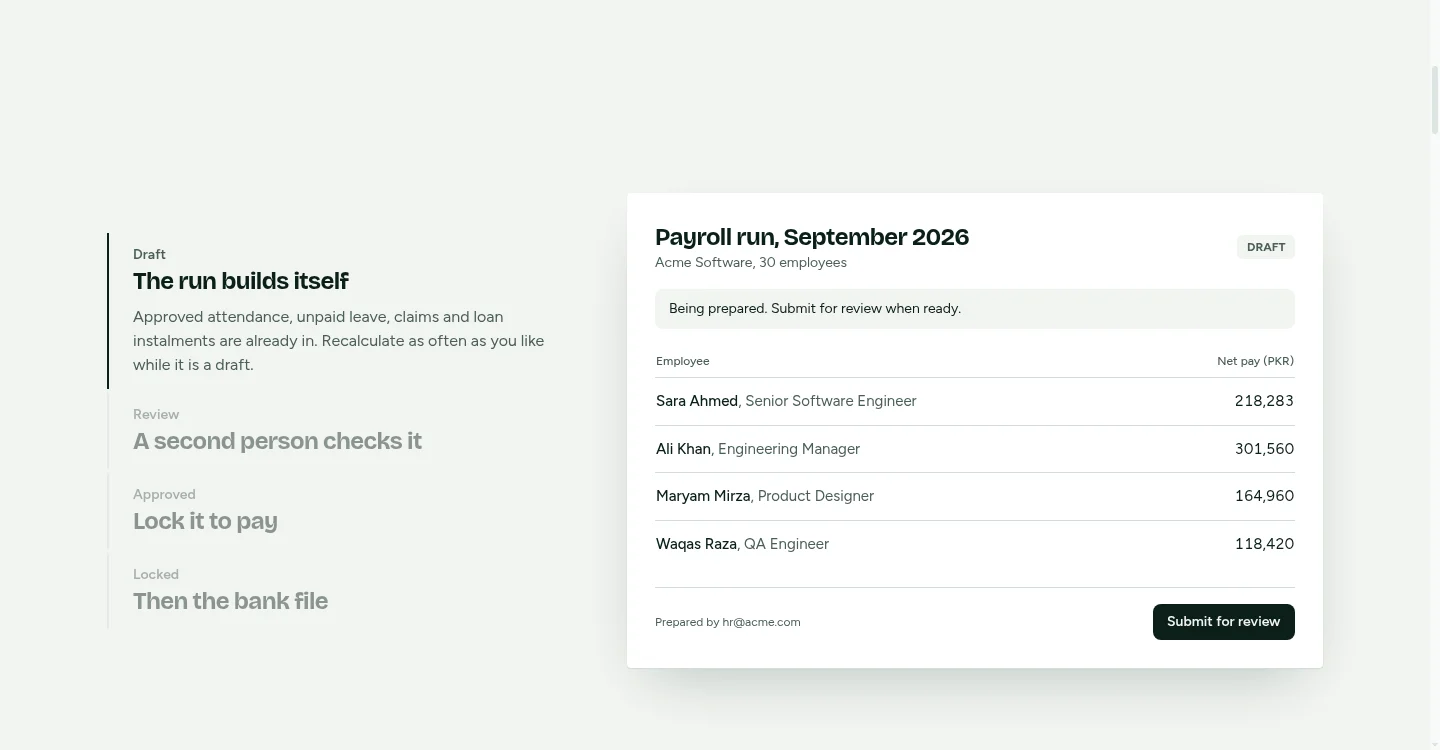
- Draft: the run builds itself from approved attendance, unpaid leave, claims and loan instalments, and can be recalculated freely.
- Review: a second person checks the numbers.
- Approved: the run is locked, payslips are generated and archived.
- Paid: the bank file is exported and the accounting journal is checked.
3Why does it take two people?
The mistakes that cost the most are the ones nobody else looked at. Enforcing the rule in the system, rather than in a policy document, means the preparer simply cannot approve their own run.
4Who does what
| Role | Can | Cannot |
|---|---|---|
| Payroll preparer | Build and recalculate the draft run, attach notes | Approve the run, change bank details on their own |
| Approver (finance or a director) | Review, approve or send back the run | Edit figures inside the run |
| HR | Maintain employee records, salaries and joiners/leavers | Approve a run they prepared |
| Managers | Approve leave, overtime and claims for their team | See salaries outside their team |
| Employees | See their own payslips and balances | See anyone else's |
Separating these roles is the control. A system that enforces them is stronger than a policy that asks people to follow them.
5What should the approver check?
Approving is not re-adding the columns. It is looking at what changed:
- Total gross and net pay against last month. Explain any change above a set percentage.
- Employees whose net pay moved by more than, say, 10%. Each should have a reason: overtime, unpaid leave, a raise, a loan deduction.
- Joiners and leavers. Every new name should match an approved hire; every leaver should be gone.
- Bank details changed since last month. The single most common route for payroll fraud.
- Loans and advances. Instalments recovered, balances reducing.
An illustration
Last month's net pay was Rs 4,820,000; this month's draft is Rs 4,975,000, up 3.2%. The exception list shows three new joiners (Rs 210,000), one leaver (−Rs 95,000), overtime in the warehouse (Rs 64,000) and one employee whose bank account changed on the 27th. The first three match approved documents. The bank change is checked with the employee by phone before approval. That is a five-minute review that would have caught the most expensive error.
6What about tax and contribution rules?
Payroll in Pakistan involves income tax, EOBI and provident fund. Income tax is withheld each month under FBR's salary slabs, which change with each budget. EOBI is not a share of actual salary: EOBI's contribution rules set 1% from the employee and 5% from the employer, both of the minimum wage (last verified 22 October 2026). Keep these in a rule set that is versioned by effective date and confirm the current rates with your tax advisor before a live run. A new rule should apply from its start date without rewriting history. To check a single salary against the 2026-27 slabs, use our salary calculator for Pakistan.
7What should you check before the bank file?
- Employees with an invalid bank account number are left out and listed, not silently dropped.
- The accounting journal balances before it is exported.
- Every change is in an audit log showing who did what and when.
8Common payroll fraud patterns
| Pattern | How it hides | The control that catches it |
|---|---|---|
| Ghost employee | A name on payroll with no real person | Every payslip tied to an approved, active employee record |
| Changed bank details | An employee's salary diverted to another account | Bank changes need a second check and appear on the exception list |
| Inflated overtime | Hours added after the manager approved them | Overtime flows from approved attendance, not typed in |
| Duplicate claims | The same receipt claimed twice | Claims filed once, in one system, with the receipt attached |
| Loan not recovered | Instalments quietly stopped | Loan balances reported every run |
9How do you handle corrections after approval?
Mistakes found after a run is locked should not be fixed by editing history. Post an adjustment in the next run, with a note explaining it, so the audit trail shows the original figure, the correction and who authorised it.
For urgent cases, such as an overpayment, a controlled reopen with a second approver and a logged reason is safer than a quiet edit.
10Who should be able to see payroll?
Payroll holds some of the most sensitive data in a company. Give access by role: the preparer sees what they need to prepare, the approver sees the totals and exceptions, and department heads see only their own team’s attendance. Log every view of salary data, and remove access the day someone changes role or leaves.
11A month-end checklist
- Attendance for the month is closed and approved.
- Leave, claims and loan instalments are approved and posted.
- New joiners, leavers and salary changes are confirmed.
- The draft run is reviewed against last month, and large differences are explained.
- A second person approves, the run locks, and payslips and the bank file are generated.
12Putting it into practice
MatrixHR connects attendance, leave, expense claims and loans to a payroll run that a second person approves, then out as payslips and a bank file. Whatever tool you use, the principle is the same: one source for each number, and two sets of eyes before money moves.
Sources
- Federal Board of Revenue, Income tax basics
- Federal Board of Revenue, Circular No. 01 of 2025-26 (salary tax rates)
- EOBI, Contributions (5% employer, 1% employee, of the minimum wage) — last verified 22 October 2026
- Employees’ Old-Age Benefits Institution (EOBI)
- Employees’ Old-Age Benefits Act, 1976
Rates, thresholds and rules change. Confirm current figures with the issuing body or your advisor before relying on them.