
Textile ERP software in Pakistan has one job above all others: following material from the moment it arrives to the moment it leaves the gate, through every stage in between, so the cost of each metre or piece is a figure you can trust. Spinning, weaving, processing and stitching each lose a little material, and each hands work to the next stage or to an outside processor. When those handovers are recorded on paper or in separate spreadsheets, the losses add up quietly. This guide sets out what each stage needs to record, how to cost the output, and how to choose a system that fits your floor.
1Where textile margins leak
Most textile units do not lose money on price. They lose it between stages:
- Yarn issued, not consumed. More yarn leaves the store than ends up in fabric, and nobody records the difference.
- Job work not reconciled. Fabric goes out for dyeing or printing and comes back short, and the shortfall is never charged or written off.
- Wastage averaged away. Shrinkage, cutting waste and rejections are spread over the month instead of recorded where they happen.
- Dispatch not matched to billing. The gate pass says one quantity and the invoice says another.
- Stale costs. Yarn or chemical prices move, but cost sheets are updated once a year.
A textile ERP closes these gaps by recording each movement once, where it happens, and carrying it through to stock, cost and the books.
2What each stage should record
| Stage | Record at minimum | Common leak |
|---|---|---|
| Raw material receipt | Supplier, lot, quantity, rate, quality grade | Short receipts accepted at invoice quantity |
| Issue to production | Lot issued, quantity, machine or line, shift | Issues not tied to an order |
| Spinning or weaving | Output per shift and machine, waste, rejects | Waste never weighed |
| Processing (dyeing, printing, finishing) | Lot sent out or processed in-house, quantity in and out | Shrinkage not recorded per lot |
| Stitching (garments) | Cut quantity, pieces stitched, rejects, piece-rate labour | Cutting waste mixed into general wastage |
| Finished goods | Quantity, grade, lot, location | Seconds counted as firsts |
| Dispatch | Gate pass, client, order, quantity | Gate pass and invoice disagree |
The right-hand column is where to look first. Each leak is a place where material left one record and never arrived in the next.
3Job work and outside processors
Many Pakistani units send fabric out for dyeing, printing, embroidery or stitching. Treat every job-work trip as a pair of movements on the same record:
- Out: a gate pass for the fabric or cut panels going to the processor, by lot and quantity.
- In: a receipt for what came back, by lot and quantity, with the processor's wastage.
- Reconcile: the difference between out and in, against the agreed wastage allowance, charged to the processor or written off with a reason.
A system that links the out and in movements shows, at any moment, how much of your material is sitting at each processor.
4Costing a metre or a piece
Cost in the unit you sell in. A worked example, with illustrative figures, for a weaving unit costing one order of 10,000 metres:
| Cost line | Amount |
|---|---|
| Yarn consumed, costed FIFO at the lots actually issued | Rs 2,600,000 |
| Sizing and other consumables | Rs 180,000 |
| Power and fuel for the order's shifts | Rs 420,000 |
| Direct labour | Rs 300,000 |
| Overhead share (machine hours) | Rs 500,000 |
| Total | Rs 4,000,000 |
| Good output after waste | 9,500 metres |
| Cost per good metre | about Rs 421 |
Two details make the number honest. Yarn is costed at the lots actually consumed, not an average for the year, and the cost is divided by good output after waste, not by the length planned. Our guide to product costing for factories walks through FIFO and overhead allocation in more detail.
For garments, the same logic applies per piece: fabric consumed per piece including cutting waste, trims, stitching labour (often piece-rate), finishing and packing, and an overhead share.
5Dispatch: one entry, three records
At the gate, a dispatch should do three things at once: reduce finished-goods stock, update the client's ledger, and post a balanced entry in the books. If those happen in three places on three different days, they will disagree. A gate pass with a QR code that the security guard scans, and that posts the dispatch when it is scanned, removes the re-typing. See how that works on our QR code gate pass system page, with a free gate pass format to download.
6Who should see what
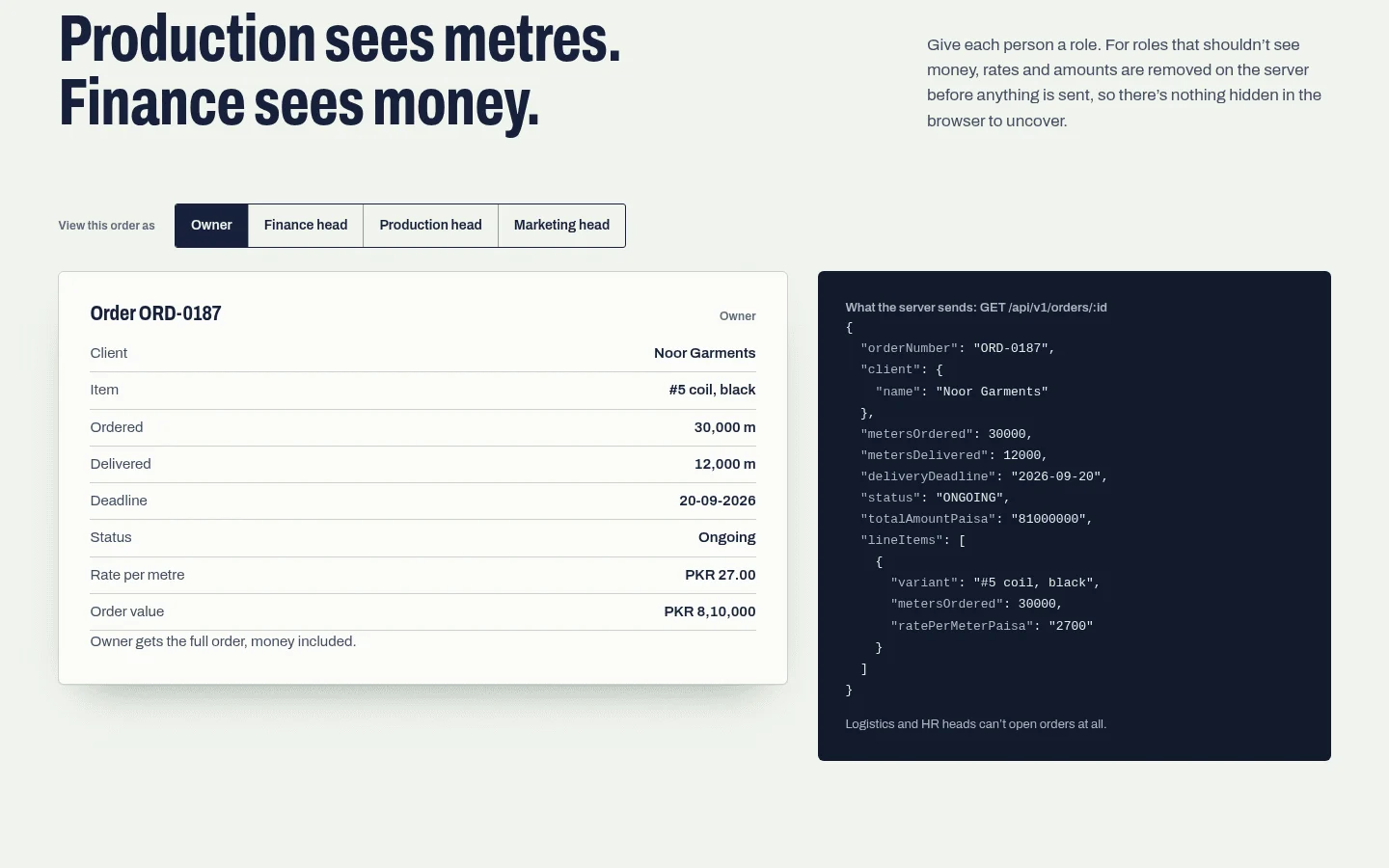
Textile units have many hands on the same records, and not all of them need to see money:
- Floor supervisors and machine operators: quantities, orders and their own shift's output.
- Store and gate staff: receipts, issues and gate passes, without rates.
- Production and marketing heads: orders and quantities, without rates or amounts.
- Finance and the owner: everything, including rates, costs, client balances and margins.
Hiding rates from people who do not need them is not about distrust. It reduces the number of people who can change a price by mistake, and keeps commercial terms private.
7Choosing textile ERP software: a checklist
- It measures in the unit you sell in: metres, kilograms or pieces.
- It tracks material by lot from receipt to dispatch.
- It records wastage at each stage, not as a month-end average.
- It handles job work out and in on the same record.
- It costs output at the lots actually consumed (FIFO or weighted average, consistently).
- Each gate pass posts stock, the client ledger and the books together.
- Floor staff can be kept away from rates and amounts.
- You can try it on one order of your own before you commit.
8How Batchbook fits
Batchbook is our manufacturing ERP: shift production logs, recipes that mix raw materials into a product, FIFO batches, product costing with overheads, and gate passes that post the client ledger and double-entry books in one step, with rates hidden from floor staff. It was built at a plastic-zipper factory, and its machinery is general. One limit matters for textiles: output is measured in metres today. That suits units that sell by the metre; if you count in kilograms or pieces, talk to us before you start. If your process needs something Batchbook does not do, we build it as custom ERP development around your floor.
Sources
Rates, thresholds and rules change. Confirm current figures with the issuing body or your advisor before relying on them.