
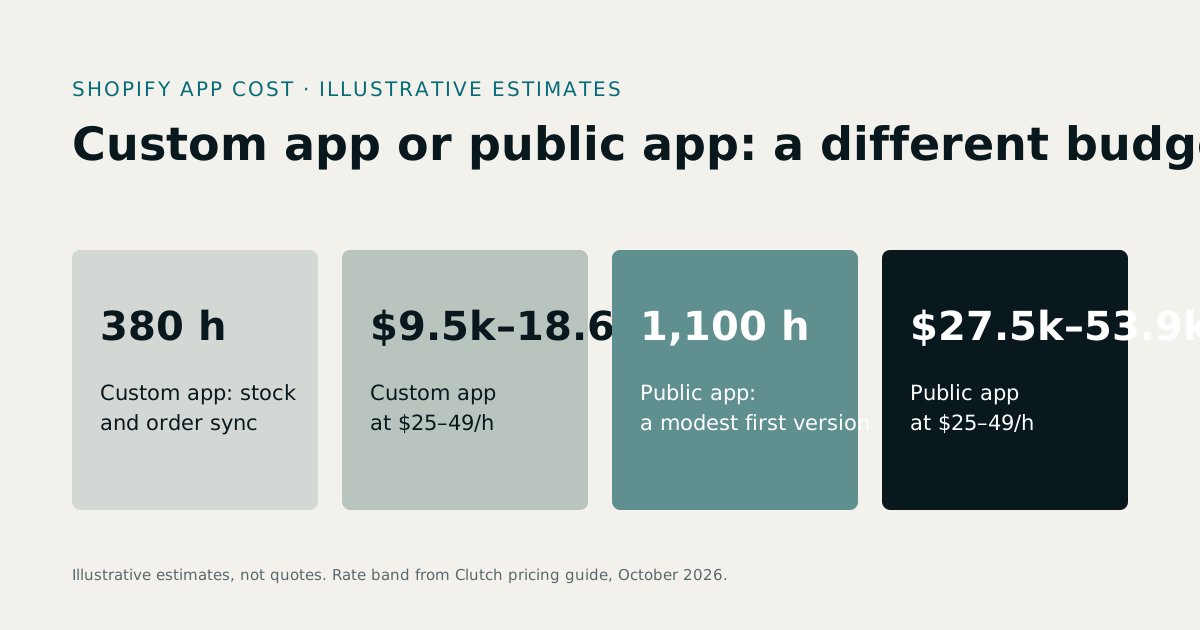
Shopify app development cost depends first on one question: is this a custom app for your own store, or a public app for the Shopify App Store? A custom app that keeps stock and orders in step with your ERP comes to about 380 hours in our illustrative estimate below, or $9,500 to $18,620 at the $25 to $49 an hour that Clutch's October 2026 guide says most development companies charge. A public app is a product, and costs several times more. To scope one, see Shopify app development services.
1Custom app or public app?
The cost to build a Shopify app, and the Shopify custom app cost in particular, depends first on this choice.
| Custom app | Public App Store app | |
|---|---|---|
| Installed on | One store (or one merchant's stores) | Any store, from the App Store |
| Review | No App Store review | Shopify's review before listing |
| Billing | None needed | Subscriptions through Shopify's billing |
| Support | Your team | Thousands of merchants |
| Typical use | Connect your store to your own systems | A product you sell to other merchants |
Most merchants need a custom app. Agencies and software companies building a product need a public one.
2A worked estimate: custom inventory and order sync
An illustrative example, not a quote: a merchant runs Shopify for its online store and an ERP for its warehouse. It wants stock levels pushed from the ERP to Shopify, orders pushed from Shopify to the ERP, and a daily report of anything that failed to sync.
| Item | Hours (estimate) |
|---|---|
| Discovery: which system owns products, prices, stock and orders | 30 |
| App setup, authentication and a small back end | 40 |
| Product and variant mapping between the two systems | 60 |
| Stock sync with rate-limit handling and retries | 80 |
| Order sync with webhooks, idempotency and error queue | 90 |
| Reconciliation report and alerts | 40 |
| Testing on a development store with real catalogue data | 30 |
| Launch and monitoring | 10 |
| Total | 380 hours |
At $25 to $49 an hour that is $9,500 to $18,620; at the $50 to $99 typical of US firms, $19,000 to $37,620. The sync logic, not the screens, takes most of the time: webhooks arrive out of order, APIs have rate limits, and two systems both believe they own the stock.
3A worked estimate: a modest public app
An illustrative example, not a quote: a public app that adds customer-specific price lists to a store.
| Item | Hours (estimate) |
|---|---|
| Product discovery and specification | 60 |
| App back end, multi-store data model and authentication | 160 |
| Admin interface inside Shopify | 220 |
| Storefront integration | 160 |
| Subscription billing through Shopify | 60 |
| Onboarding, settings and help content | 90 |
| Testing across themes and store sizes | 140 |
| App Store listing, review and fixes | 60 |
| Monitoring, logging and support tooling | 70 |
| Contingency for review feedback and API changes | 80 |
| Total | 1,100 hours |
That is $27,500 to $53,900 at $25 to $49 an hour. A public app also needs marketing, support staff and ongoing updates, which are business costs beyond the build.
4Shopify's revenue share
For public apps, Shopify's developer documentation (checked 23 October 2026) says developers keep 100% of their first $1,000,000 in gross app revenue and 85% of revenue above that, after registering with a one-time $19 fee. Developers above certain size thresholds pay 15% on all app revenue. Check the current terms before you build a business case.
5What drives the cost
- Which APIs and webhooks the app uses, and their rate limits.
- How many systems it connects, and how clean their data is.
- Who owns which data: one source of truth per field avoids endless conflicts.
- Admin screens: a background sync needs few; a merchant-facing tool needs many.
- Public or custom: billing, multi-store support and review multiply the work.
6How to cut the cost
- Check the App Store first. An existing app may already do most of it.
- Sync one direction first, for example stock from ERP to Shopify, then add orders.
- Keep the app small: store only what you must, and let each system own its data.
- Build a reconciliation report from day one, so mismatches are caught by software, not customers.
7How to compare quotes
Ask each bidder: which system is the source of truth for each field; how rate limits, retries and duplicate webhooks are handled; what the reconciliation report shows; who hosts the app and who owns the code; and can we see a Shopify app you built that is running today?
8Costs after launch
A Shopify app keeps costing a little after it ships:
- Hosting for the app's back end and database. Small for a custom app, larger for a public app with many stores.
- API versions. Shopify releases new API versions on a regular schedule and retires old ones, so apps need periodic updates to keep working.
- Monitoring of sync failures, webhook errors and performance.
- Support, especially for public apps, where every merchant's store and theme is a little different.
- Changes, as your catalogue, your ERP or your processes change.
Budget for these every year. For a custom sync app they are modest; for a public app they are part of running a business.
9Build, buy or adapt
| Route | Cost | Best when |
|---|---|---|
| An existing App Store app | A monthly subscription | It covers most of what you need |
| An existing app plus a small custom app | Subscription plus a small build | One gap remains, such as a sync to your own system |
| A custom app | A project fee plus hosting | Your systems or rules are unusual |
| A public app | A product budget plus ongoing support | You plan to sell the app to other merchants |
Try the cheaper routes first. Many merchants find that an existing app plus one small custom integration covers everything.
10Questions to answer before you request quotes
- Which system owns products, prices, stock, orders and customers?
- How fresh must stock be in Shopify: seconds, minutes or hours?
- How many products, variants and orders per day?
- What should happen when a sync fails?
- Who will look at the reconciliation report, and how often?
11A short glossary
- Custom app: an app built for one store or one merchant, installed directly rather than through the App Store.
- Public app: an app listed in the Shopify App Store, available to any merchant after Shopify's review.
- Admin API: Shopify's interface for reading and changing products, orders, customers and inventory.
- Webhook: a message Shopify sends to your app when something happens, such as a new order.
- Rate limit: the maximum number of API requests an app may make in a period; bulk updates must be paced.
- Idempotent update: an update that can safely be applied twice without doing harm, essential when webhooks repeat.
- Source of truth: the system that owns a piece of data; the others follow it.
Understanding these terms makes it much easier to read a Shopify quote and to see where the effort goes.
12The bottom line
For most merchants, the right budget is for a small custom app that keeps Shopify in step with the system that owns their stock and orders. A public app is a product, and deserves a product's business plan before anyone writes code.
13What Treevoxa charges
We quote Shopify work in US dollars and in writing, after mapping your data with you. The stock problem is one we solve in our own product, PharmaFlow, where a pharmacy's online store and counter share one stock record. See Shopify app development services, or our custom software development cost guide for software prices in general.
Sources
- Shopify, Revenue share for Shopify App Store developers — last verified 23 October 2026
- Clutch, Software Development Company Pricing Guide (October 2026) — last verified 23 October 2026
Rates, thresholds and rules change. Confirm current figures with the issuing body or your advisor before relying on them.