
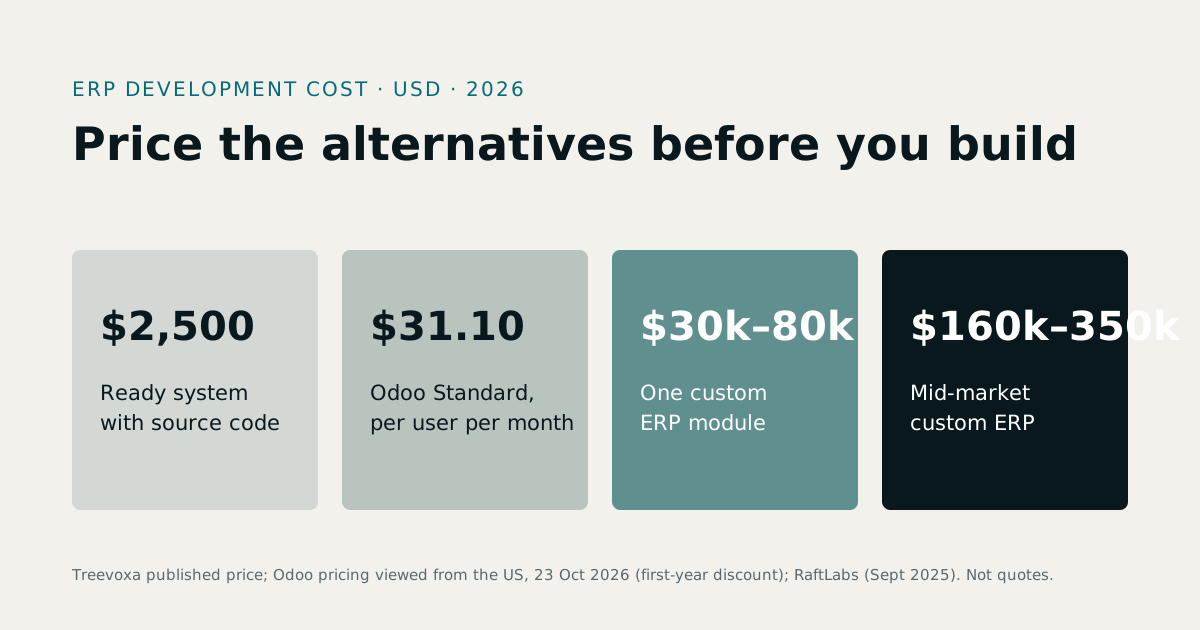
ERP development cost in 2026 runs from roughly $30,000 to $80,000 for one custom module to $160,000 to $350,000 for a mid-market system of five to seven modules, according to the figures RaftLabs publishes. Cheaper routes exist: configuring Odoo or ERPNext, or buying a ready system with its source code. This guide explains what drives the number, how to compare quotes, and when each route makes sense. If you already know you need a custom build, see our ERP software development service.
1What is ERP development?
An ERP (enterprise resource planning) system keeps the records a business runs on in one place: stock, purchasing, production, sales, HR and payroll, and the accounts. ERP development means building such a system, or building the parts that a ready ERP does not cover. The point of an ERP is that one event, such as a dispatch, updates every record it touches once: stock goes down, the customer's ledger goes up, and the books stay balanced, without anyone typing the same numbers twice.
2ERP system development cost at a glance
| What you are buying | Published figure (USD) | Source |
|---|---|---|
| One custom ERP module | $30,000 to $80,000 | RaftLabs |
| Mid-market custom ERP (five to seven modules) | $160,000 to $350,000 | RaftLabs |
| Typical custom software project on Clutch | $10,000 to $49,999 | Clutch, October 2026 |
| Odoo Standard plan | US$ 31.10 per user per month (US$ 38.90 after the 12-month discount) | Odoo, viewed from the US |
| Odoo Custom plan (Studio, custom modules) | US$ 61.00 per user per month (US$ 76.20 after the discount) | Odoo, viewed from the US |
| ERPNext on Frappe Cloud | From $5 a month for a shared site; the software is open source | Frappe |
| A ready ERP-class system with full source code | $2,500 one-time | Treevoxa |
These figures measure different things. A custom module is a one-time build; Odoo is a monthly fee per user that grows with your team; ERPNext is free software that you pay a partner to configure. Compare them over three to five years, not on the first invoice.
3What drives the cost of an ERP
- The number of modules. Inventory, purchasing, sales, production, HR, payroll and accounting are each a module with their own screens, rules and reports.
- How unusual your process is. Standard flows are cheap to build and cheap to buy. Unusual costing, approvals or pricing rules are where custom work earns its price and where it costs the most.
- Integrations. Each connection to a bank, an e-commerce store, a courier, a biometric device or an accounting package needs mapping, error handling and testing.
- Data migration. Years of item codes, balances and open orders must be cleaned and moved. Messy data can cost as much as a module.
- Permissions and audit. Who can see costs, who can approve a payment, and what the audit log records.
- Users and locations. Multiple branches, warehouses, companies and currencies multiply the rules.
- Reports. Every month-end report your accountant or owner relies on must be rebuilt and checked against the old numbers.
- Support after launch. Hosting, backups, upgrades and changes, for as long as the system runs.
4Manufacturing ERP software development cost
Manufacturing adds a layer that trading businesses do not have: recipes or bills of materials, shift production logs, batches, scrap and yield, and costing that turns all of that into a cost per unit. Price these as separate modules. In our own Batchbook ERP, one gate pass moves finished goods out of stock, posts the invoice to the client's ledger and applies the cost price, and that single flow touches four modules. Our guide to product costing with FIFO explains the costing logic that a manufacturing ERP has to get right.
5A worked estimate for a custom ERP
An illustrative example, not a quote: a distributor with two warehouses wants inventory, purchasing, sales and accounts, with a connection to its online store and five years of data to migrate.
| Item | Hours (estimate) |
|---|---|
| Discovery and written specification | 80 |
| Inventory with two warehouses and transfers | 220 |
| Purchasing and supplier balances | 140 |
| Sales, invoicing and customer balances | 180 |
| Double-entry accounts and month-end reports | 200 |
| Online store integration | 90 |
| Data migration and reconciliation | 120 |
| Testing, training and launch | 130 |
| Total | 1,160 hours |
At the $25 to $49 an hour most development companies on Clutch charge, that is about $29,000 to $57,000; at the $50 to $99 typical of US firms, about $58,000 to $115,000. The hours, not the rate, are where quotes differ most, so ask every bidder for a breakdown like this one.
6Cheaper routes to consider first
- Configure a general ERP. If your process is standard for your trade, Odoo or ERPNext configured by a partner is often cheaper over five years. Our custom ERP vs Odoo vs ERPNext comparison sets out the trade-offs with each vendor's own prices.
- Buy a ready system with source code. If a working system already covers most of your process, buying its code and paying only for the changes can cost a fraction of a build. See ERP software with source code.
- Build only the part that is different. Many businesses run standard accounting in a ready product and build one custom system for the process that sets them apart, connected through an API.
7How to get ERP quotes you can compare
Send every bidder the same written brief:
- what the business does, how many users and locations;
- the modules you need, and the three processes that are unusual;
- every system and device it must connect to;
- how much data you have, and where it lives;
- the month-end reports you cannot live without;
- who approves what, and who must not see what.
Then ask each one: is the price fixed for this scope or estimated hours at a rate; what is excluded (design, testing, migration, hosting, training); who owns the code and the data; how are changes priced; and can you see an ERP they built that is running today?
8ERP development cost by module
Each module has its own cost drivers. Use this list to read a quote, and to ask why a module is priced the way it is:
- Inventory. Locations, units of measure, batches or serial numbers, transfers and stock counts. Batch and expiry tracking roughly doubles the work of a simple stock list.
- Purchasing. Purchase orders, partial deliveries, supplier balances and approvals. Landed costs, such as freight and duty spread over items, add more.
- Sales. Quotes, orders, invoices, credit limits and customer balances. Price lists by customer and discount approvals are where the hours go.
- Production. Recipes or bills of materials, work orders, shift logs, scrap and yield. The most variable module, because every factory works differently.
- Accounting. Chart of accounts, journals, ledgers, bank reconciliation and the month-end reports. Every other module posts here, so it is never optional.
- HR and payroll. Often bought separately; see our guide to HRMS software development cost.
- Reporting. Dashboards and the exact reports your owner and accountant read each month.
9The hidden costs of an ERP project
The build is the visible part. Plan for these as well:
- Your team's time. Someone must explain the process, answer questions, test each module and sign it off. On a mid-size project that can be a day a week for months.
- Data cleaning. Duplicate items, inconsistent codes and balances that never reconciled must be fixed before migration, not after.
- Training. Every user needs to learn the new way of working; the busiest staff are the hardest to schedule.
- A parallel run. Running old and new systems side by side for a month doubles the workload but catches the errors that matter.
- Change after launch. Once people use the system, they ask for changes. Budget for a steady flow of them in the first year.
10How long an ERP project takes
Duration follows scope. A single module with clean data can be live in weeks; a multi-module system with migration and training takes months. Phasing is the usual answer: launch inventory and sales first, add purchasing and accounts next, and leave production or HR for a later phase. Each phase delivers value on its own and reduces the risk of one big switch-over.
11What Treevoxa charges
We quote ERP work per project, in US dollars and in writing, after the scope is fixed, and we reply to a brief within one business day. Most of our projects start from systems we already run, such as Batchbook, MatrixHR and RE-ERP, so you can click through a working demo before you commit. See ERP software development for how we scope a build, or our custom software development cost guide for software prices in general.
Sources
- RaftLabs, Custom ERP development cost (updated September 2025) — last verified 22 October 2026
- Odoo, Pricing (viewed from the United States) — last verified 23 October 2026
- Frappe, ERPNext pricing — last verified 22 October 2026
- Clutch, Software Development Company Pricing Guide (October 2026) — last verified 23 October 2026
Rates, thresholds and rules change. Confirm current figures with the issuing body or your advisor before relying on them.