
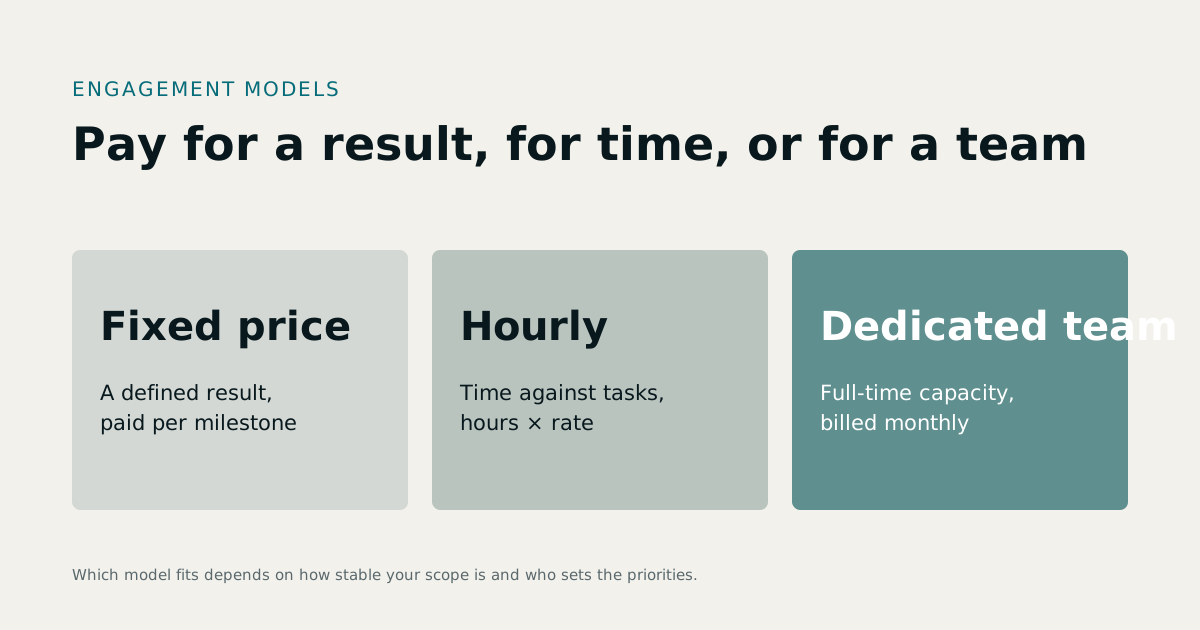
The dedicated development team model is an engagement where you pay a vendor monthly for developers who work only on your product, while you decide what they build each week. It suits products that keep changing, such as a SaaS product after launch or an internal system that grows with the business. For a stable, well-specified project, a fixed price is usually the better buy. If you are ready to staff a team, see hire dedicated developers.
1How the model works
- You own the priorities. A backlog, a weekly planning session, and the right to change direction without renegotiating a contract.
- The vendor owns the people. Recruiting, payroll, equipment, training, holidays and replacement when someone leaves.
- The team works in your tools. Your repository, your issue tracker, your chat, so knowledge stays with you.
- You pay for capacity. A monthly fee per developer, whatever the backlog holds that month.
2Dedicated team vs fixed price vs hourly
| Fixed price | Hourly | Dedicated team | |
|---|---|---|---|
| You buy | A defined result | Time against tasks | Full-time capacity |
| Price | Agreed up front, per milestone | Hours × rate | Monthly per developer |
| Who carries scope risk | The vendor | You | You |
| Changing direction | A change request | Easy | Easy |
| Best for | A clear, stable specification | Small tasks, audits, support | Ongoing product work |
The fixed-price column moves risk to the vendor, which is priced in. The dedicated column keeps risk with you but rewards a clear product owner with more output per dollar over a long engagement.
3What a dedicated team costs: dedicated team pricing
The cost signals worth knowing:
- US employee. The Bureau of Labor Statistics puts the median software developer salary at $135,980 a year (May 2025). Benefits, payroll taxes, equipment, software and recruiting come on top.
- Agency time. Clutch's October 2026 pricing guide puts most development companies on its directory at $25 to $49 an hour, US firms typically at $50 to $99, and Canadian and Australian firms at $100 to $149.
Dedicated developers are usually priced per month rather than per hour. As illustrative arithmetic only, a full-time month of about 160 working hours at $25 to $49 an hour comes to $4,000 to $7,840. Use that to sanity-check a monthly quote, then compare what is included: a team lead, testing, project management, and how holidays and sick days are covered.
4When the model works, and when it fails
It works when:
- There is a product owner on your side who can prioritise, answer questions and accept work every week.
- The work is ongoing. A roadmap of improvements, not a single project with an end date.
- The team is stable. The same people for months, building knowledge of your product.
It fails when:
- nobody on your side has time to set priorities, so the team guesses;
- the engagement is really a fixed project that would be cheaper as one;
- people rotate so often that knowledge never builds up;
- nothing is written down, so every disagreement becomes a negotiation.
5An offshore dedicated development team
Most dedicated teams are offshore or nearshore, because that is where the cost difference is. What makes an offshore team succeed is not the rate; it is a daily overlap window inside your business hours, one named lead on each side, response times outside the window, and a written weekly update. Our page on offshore software development explains how we set those up, and custom software development rates compares regions.
6What to put in the contract
- Named people, and how a replacement is proposed, approved and handed over.
- The monthly fee, what it includes, and how extra hours are billed.
- Working hours: the overlap window, holidays, and response times.
- The term and the notice period, and the handover at the end.
- Ownership: code, designs and data are yours, in your repository from the first commit.
- Confidentiality and data protection, under the law that applies to you.
- Reporting: a written weekly summary of what was done, what is next and what is blocked.
7Running a dedicated team well
- Write the backlog down. A short description and acceptance criteria for every item, in priority order.
- Plan weekly, demo weekly. Fifteen minutes to agree the week, thirty to see working software at the end of it.
- Review code, not hours. Look at pull requests and running software; timesheets tell you little.
- Keep one owner. Several people giving the team conflicting priorities is the fastest way to waste a month.
- Check in monthly on output, quality and fit, and change the team's shape if needed.
8What a dedicated team looks like in practice
A typical small dedicated team for a product after launch might include two or three developers, a part-time lead who reviews code and plans with you, and testing built into the developers' work. As the product grows, the shape changes: a designer for a new feature set, a mobile developer when you add an app, or fewer people during a quiet period.
A week usually runs like this:
- Monday: a short planning call. You confirm the priorities; the team agrees what it will finish this week.
- Every day: a few minutes of written or spoken updates inside the overlap window, plus quick questions answered in your chat tool.
- During the week: code is reviewed and merged into your repository; finished work is deployed to a staging site.
- Friday: a demo of what was built, and a written summary of what is done, what is next and what is blocked.
9Dedicated team vs hiring in-house
| Dedicated team | In-house hire | |
|---|---|---|
| Time to start | Weeks | Often months of recruiting |
| Fixed costs | Monthly fee only | Salary, benefits, equipment, office, recruiting |
| Flexibility | Scale up or down with notice | Hard to reduce |
| Knowledge retention | Depends on team stability and documentation | Stays with the employee while they stay |
| Management | Vendor manages people; you manage priorities | You manage everything |
Many companies use both: an in-house lead who owns the product and the architecture, and a dedicated team that adds capacity.
10How to measure whether it is working
Hours are a poor measure. Look instead at:
- Working software shipped each week, visible on staging or in production.
- How long a change takes from agreed to live.
- Quality: bugs found after release, and how quickly they are fixed.
- Predictability: whether the team finishes what it planned most weeks.
- Your own time: a good team needs clear priorities from you, not constant supervision.
Review these monthly, and adjust the team's size or shape if the numbers drift.
11Red flags when choosing a vendor
- They will not name the people who will work on your product.
- The code lives in their repository, not yours.
- They cannot show you software they built that is live today.
- The contract is silent on replacement, notice and handover.
- Every question about price is answered with "it depends", and nothing is put in writing.
- They promise any skill you ask for, immediately.
A good vendor is specific: names, terms, live work and a written proposal. Treat vagueness at the start as a preview of the engagement.
12The bottom line
A dedicated team is the right buy when the work is ongoing and someone on your side can set priorities every week. Get the people, the hours and the ownership in writing, measure working software rather than hours, and review the arrangement every month.
13Getting started
Most teams start small: one or two developers and a first task that proves the setup, before growing. If you need a dedicated team, tell us the roles, the stack and the hours you need covered; see hire dedicated developers. If the work is a defined project rather than ongoing capacity, our custom software development cost guide explains fixed-price quotes.
Sources
- U.S. Bureau of Labor Statistics, Occupational Outlook Handbook: Software Developers — last verified 23 October 2026
- Clutch, Software Development Company Pricing Guide (October 2026) — last verified 23 October 2026
Rates, thresholds and rules change. Confirm current figures with the issuing body or your advisor before relying on them.