
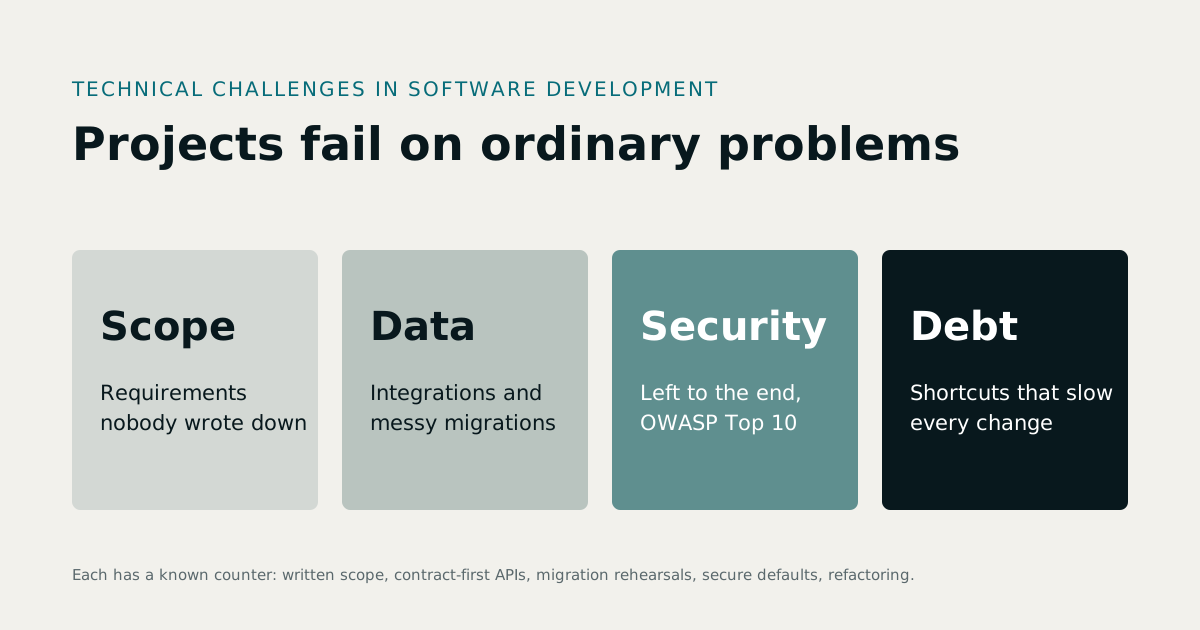
The technical challenges in software development that sink projects are rarely exotic. They are the same few problems, again and again: requirements nobody wrote down, integrations discovered late, data that is messier than anyone admitted, security left for the end, performance that collapses with real users, and technical debt that slows every change. This guide takes each in turn and sets out how experienced teams handle it. If your project is already struggling, our software design consulting starts with exactly this kind of review.
11. Unclear requirements
The problem. The team builds what it thinks you meant. You discover the gap when you test, and every fix moves the date.
What works.
- Write the scope down: users, roles, the main workflows, the reports and every integration, before anyone quotes.
- Describe each feature by what a user does and what they should see, with an example.
- List what is deliberately out of scope. It prevents more arguments than anything else.
- Show working software early, on a staging site, so misunderstandings surface in week two, not month four.
22. Integrations with other systems
The problem. Two systems each assume something about the other: the data format, who owns a record, what happens on an error, how many requests per minute are allowed. Integrations are where estimates are most often wrong.
What works.
- Map every system involved, what data moves, in which direction and how often.
- Agree a contract for each integration, ideally as an OpenAPI document, before building either side.
- Design for failure: retries, idempotent updates, an error queue and a reconciliation report.
- Test against the real system, or a faithful sandbox, as early as possible.
Our API development services page explains how we build integrations this way.
33. Data migration
The problem. Years of records in spreadsheets or an old system: duplicates, free text where codes should be, balances that never reconciled. Migration is treated as a weekend task and becomes a month.
What works.
- Inventory the data early: sources, volumes, quality.
- Write mapping rules and agree them with the people who own the data.
- Rehearse the migration at least once on a copy, and reconcile totals against the old system.
- Plan a cut-over date with a freeze on changes in the old system.
44. Security left for the end
The problem. Security added after the fact is expensive and incomplete. The same weaknesses appear edition after edition in the OWASP Top 10, with broken access control, injection and insecure design among them.
What works.
- Treat security as a design input, not a test phase. NIST's Secure Software Development Framework (SP 800-218) sets out practices for every stage, from preparing the organisation to responding to vulnerabilities.
- Check permissions on every endpoint, not just in the user interface.
- Validate all input, keep secrets out of the code, and keep dependencies updated.
- Log sensitive actions, so you can tell who did what.
55. Performance and scale
The problem. The system is fast with ten test records and slow with a hundred thousand real ones. Usually the cause is a few queries, not the language or the framework.
What works.
- Test with realistic data volumes before launch.
- Index the queries your main screens use, and paginate long lists.
- Measure before optimising: find the slow endpoint, then the slow query.
- Move slow work, such as reports and imports, to background jobs.
66. Technical debt
The problem. Shortcuts taken to hit a date make every later change slower, until the team spends more time working around the code than improving it.
What works.
- Keep debt visible: a list, with the cost of each item in slowed work.
- Pay some down every cycle, rather than waiting for a rewrite that never comes.
- Refuse shortcuts in the places that are expensive to change: the data model, security and integrations.
- Write tests around code before changing it.
77. Delivery itself
The problem. Releases are rare, manual and frightening, so changes pile up and every release is risky.
What works. Small, frequent releases through an automated pipeline. DORA's long-running research on software delivery uses a small set of measures, including how often a team deploys, how long a change takes to reach production, how often changes fail, and how quickly service is restored. Track a few honest numbers like these instead of hours logged.
8Software development challenges that are not technical
Several of the hardest challenges are about people and contracts:
- No product owner. Someone on the client side must be able to decide, quickly.
- Changing priorities without a way to price the change.
- Unclear ownership of the code, the data and the hosting.
- Time zones without an agreed overlap, so questions wait a day.
Write these down at the start. Our guide to the dedicated development team model covers the contract terms that prevent most of them.
9A checklist of software project risks
- Scope written down, including what is out.
- Every integration mapped, with a contract.
- Data inventoried and a migration rehearsal planned.
- Permissions checked on the server for every action.
- A test with realistic data volumes before launch.
- Automated tests and a deployment pipeline.
- A named decision-maker on the client side.
- Code ownership and hosting agreed in the contract.
10Challenges specific to growing systems
Some problems only appear once a system succeeds:
- More users than expected. Screens that loaded instantly for ten users slow down for a thousand. The fix is usually a few database indexes and pagination, found by measuring, not guessing.
- More data than expected. Reports that scanned every record become unusable. Summaries, background jobs and archiving keep them fast.
- More integrations. Each new connection adds a way for data to get out of step. A reconciliation report for each integration catches problems early.
- More developers. Code that one person understood becomes hard for five. Consistent structure, code review and automated tests keep it manageable.
- More customers with different needs. Configuration grows into a tangle of special cases. A clear line between configuration and custom code, decided early, prevents it.
11A note on AI-assisted development
AI coding tools speed up many tasks, but they do not remove these challenges. They can produce code faster than a team can review it, repeat insecure patterns from their training data, and miss the business rules nobody wrote down. Treat AI-written code like any other contribution: reviewed, tested and owned by a named developer. The same discipline that handles the challenges above, written scope, contracts for integrations, tests and security by design, is what makes AI assistance safe.
12How the challenges compound
These problems rarely arrive alone. Unclear requirements lead to rushed integrations; rushed integrations corrupt data; corrupted data makes migration harder; and the pressure that follows pushes security and tests to "later". Breaking the chain early is far cheaper than untangling it at the end, which is why a written scope and a few hours spent on integration contracts are among the best-value work in any project.
13Warning signs to watch for
- Estimates are revised upwards every month.
- Bugs that were fixed come back.
- Releases need a long manual checklist and a quiet weekend.
- Only one person understands a critical part of the system.
- The team cannot show working software for something it has been building for weeks.
Each of these points to one of the challenges above, and each is cheaper to address the week it appears than the month after.
14When to bring in outside help
If your project shows the warning signs (no working software after a month, estimates that only grow, bugs that return, releases that need a long manual checklist), an outside review is usually cheaper than another month of the same. A good review looks at the code, the plan and the process, and hands you a short list of fixes ranked by risk. That is what our software design consulting delivers. For the cost side, see custom software development cost.
Sources
- OWASP Top 10 — last verified 23 October 2026
- NIST SP 800-218, Secure Software Development Framework (SSDF) — last verified 23 October 2026
- DORA, research on software delivery performance — last verified 23 October 2026
Rates, thresholds and rules change. Confirm current figures with the issuing body or your advisor before relying on them.