
To hire offshore developers for Canadian businesses, use a dedicated developer who works only on your product, with a fixed daily overlap in your hours. You can hire dedicated developers on this basis and keep the code, the repositories and the day-to-day direction in your own hands. It is one form of offshore software development. The privacy, tax and contract checks stay with you, not the vendor.
Treevoxa supplies dedicated developers this way, so we are an interested party. We have tried to be fair to every country and every route, including the ones that don't involve us.
1How do you hire offshore developers for Canadian businesses?
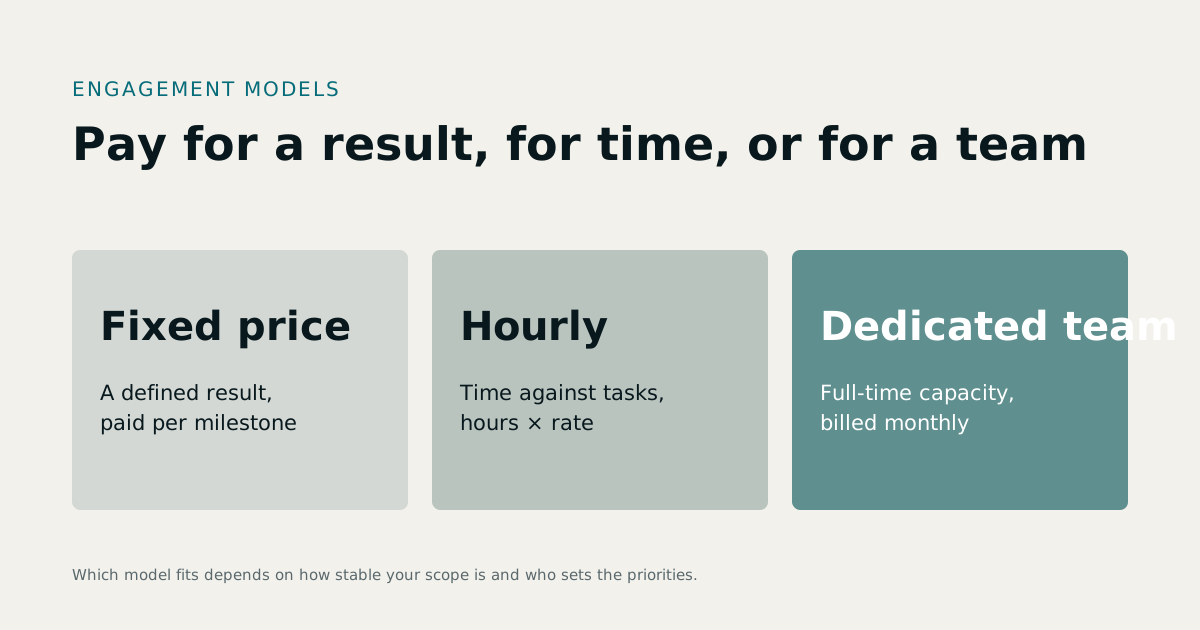
The unit of hiring is a named person, not a ticket queue. You interview them, you know their working hours, and they stand up with your team every day. That is the difference between a dedicated developer and outsourced project delivery, where the vendor owns the plan and you receive a result. Our guide to the dedicated development team model covers how it works in more detail.
A typical path from brief to first sprint:
- Write the brief. One or two pages: what the product does, the stack, the state of the code, who will direct the work, and the overlap hours you need.
- Shortlist and interview. Expect two or three candidates. Ask them to walk through a past system and explain a trade-off they made. Skip the puzzles.
- Run a trial week. Give them a small, real task in your repository, using a sandbox rather than production data.
- Sign the contract. It should cover IP assignment, confidentiality, data processing, notice and handover. Each is covered below.
- Set up access. Repositories, issue tracker and cloud accounts all sit in your organisation's accounts. The developer is invited in with least-privilege access.
- Start the first sprint. Keep it to one or two weeks, with a demo at the end. This is where you find out whether communication works.
2What does it cost to hire offshore developers, in CAD?
Published rates are mostly marketing, and they disagree. Systemskills' Canada cost guide puts Canadian developers at roughly CAD 60–120+ an hour and offshore at roughly CAD 25–75, with a saving of 40–70%. eCyberTech advertises Indian developers from CAD 22 an hour and a saving of 65–75%. Both are vendor claims. Use them as a range to test quotes against, not as facts.
For our own figures, see Treevoxa's software development rates. To price a specific scope, use the software development cost calculator. For a wider view of build costs in USD, read our custom software development cost guide.
We won't invent seniority bands, because no source we trust publishes them. What moves a quote within the range:
- Seniority and role. A developer who designs and reviews costs more than one who works through well-defined tickets.
- Stack. Common stacks have more supply. Niche ones cost more.
- Country and city. See the comparison further down.
- Contract length. Longer commitments usually price lower.
- What the fee includes. Check for management, tooling, replacement cover and holiday cover.
- Hourly or monthly. Ask what happens to public holidays and sick days.
Do you pay CPP or EI? Employer CPP and EI apply to your own Canadian employees. Check the current rates on canada.ca. Vendors such as Global BrainForce say there is no CPP or EI on their offshore teams, but that depends on who employs the developer. Confirm your structure with your accountant.
Can you be billed in CAD? Ask. If the vendor invoices in USD or another currency, you carry the exchange-rate risk. Also agree how and when you pay: monthly in arrears is common.
3Is offshore really cheaper? A worked cost comparison
Yes, but the saving depends heavily on the rate you pay and on the costs that never appear on an invoice.
| Cost line | Canadian in-house hire | Offshore dedicated developer |
|---|---|---|
| Salary or fee | A senior developer is quoted at roughly CAD 120,000–160,000 a year (Systemskills, a vendor claim) | Monthly fee, often hourly rate × about 160 hours |
| CPP, EI and benefits | Employer contributions and benefits; check current rates on canada.ca | Usually not on your payroll if the vendor employs the person; confirm with your accountant |
| Recruitment | Agency fee or internal hiring time | Often included, or a modest setup cost |
| Equipment and tooling | You buy and manage | Often vendor-supplied; you pay for tools you require |
| Management time | Normal | Extra at the start: more written briefs, more review |
| Overlap cost | None | Your meeting hours; the developer's shifted day is a cost to ask the vendor about |
| Turnover and handover | Notice period; knowledge leaves with the person | Vendor supplies a replacement, but you spend weeks getting them up to speed |
Here is an illustration for one senior developer. The assumptions are ours, so replace them with your own:
- In-house: CAD 140,000 a year, the midpoint of the vendor-quoted salary range, is about CAD 11,667 a month before employer costs. We add 10% or 20% for employer-side costs and benefits, which is an assumption, not a figure from canada.ca.
- Offshore: the hourly rate × 160 hours, plus six hours a week of extra lead time. That is about 26 hours a month at an internal cost of CAD 80 an hour, or CAD 2,080.
| Offshore rate (CAD/hr) | Offshore monthly total | Saving vs in-house, no uplift (CAD 11,667) | With 10% uplift (CAD 12,833) | With 20% uplift (CAD 14,000) |
|---|---|---|---|---|
| 25 | 6,080 | about 48% | about 53% | about 57% |
| 45 | 9,280 | about 20% | about 28% | about 34% |
| 75 | 14,080 | costs about 21% more | costs about 10% more | roughly break-even |
In our illustration, a mid-range offshore rate saves around a fifth to a third. A saving above half only appears at the bottom of the vendor range, and at the top of it there is no saving at all. The 40–75% headlines compare a rate with a salary and leave out management time.
The table also leaves out turnover and handover, which cut into the saving every time a developer leaves. Some of the value comes from capacity rather than rate. You can add a second developer in weeks, not months.
4Is it legal to hire offshore developers from Canada?
Yes, with care. Nothing stops a Canadian company from paying people abroad to write software. The risks sit in how the relationship is set up, how personal data is handled and how payments are treated for tax. This is general information, not legal advice. Have a Canadian lawyer and accountant review your structure before you sign.
The first question is status. The label on a contract does not decide it. Tax and employment authorities look at the substance: who controls how and when the work is done, whose tools and accounts are used, whether the person works exclusively for you and who carries the financial risk. A direct contractor who works full-time for you, to your schedule, on your equipment, invites questions about whether they are an employee.
That is why a dedicated developer is usually engaged by the vendor. The vendor employs them and handles their tax and benefits in their own country, and you direct the work under a service agreement. This reduces the risk but does not remove it. If you direct a vendor's developer so closely that they work as part of your staff, a lawyer should still look at the structure. Some countries also ask whether a business with a dedicated person working only for it has a taxable presence there, known as a permanent establishment. Ask your tax adviser about the country you are hiring in.
Contractor, vendor team or Employer of Record?
| Direct contractor | Vendor-supplied developer | Employer of Record (EOR) | |
|---|---|---|---|
| Who employs them | Nobody; they are self-employed | The vendor | The EOR, in the developer's country, on your behalf |
| Tax and benefits | The contractor handles their own; you carry the classification risk | The vendor | The EOR runs payroll and local compliance; you pay it a fee on top of salary |
| Day-to-day control | You, which raises status questions | You direct the work; the vendor manages the employment | You |
| Exit flexibility | Notice per the contract | Notice per the contract; the vendor can replace | Local employment law applies, so exit can be slower and costlier |
| Best for | Short, bounded tasks | Ongoing development with replacement cover | A long-term hire you chose yourself and want on your own team |
For more on contractor versus EOR, see this guide to hiring abroad from Canada.
5Do PIPEDA and Quebec Law 25 apply to offshore work?
Yes, if the developer can see personal information. That includes customer records, staff data or a copy of a production database.
PIPEDA. Your organisation stays accountable for personal information it passes to a processor, including one abroad. You need contractual or other means to give that data a comparable level of protection, and you should be open with people that it may be processed outside Canada. The Office of the Privacy Commissioner's transborder dataflows consultation is archived but still sets out the thinking. Bill C-27, which would have replaced PIPEDA with a new Consumer Privacy Protection Act, did not become law. It lapsed when Parliament was prorogued in January 2025, and PIPEDA remains the federal rule for private-sector organisations.
Quebec Law 25. Before personal information about people in Quebec is communicated outside Quebec, you must carry out a privacy impact assessment and have a written agreement that reflects the result. Practical guides to this are Law 25 transfers outside Quebec and what Law 25 requires. Check the legislation and the Commission d'accès à l'information's guidance for your case.
No vendor can be "PIPEDA ready" or "Law 25 compliant" on its own. Compliance belongs to the organisation that collects the data. A vendor can make it easier or harder, but it cannot hand you the badge.
A privacy checklist for offshore development
| Item | What to do | Why it matters |
|---|---|---|
| Processor contract | Written agreement covering purpose, security, breach notice, sub-processors and deletion | PIPEDA accountability stays with you |
| NDA | Signed by the vendor and the named developer | Confidentiality beyond the main contract |
| Access control | Least privilege, named accounts, no shared logins, MFA | Limits what any one person can see |
| Test data | Use synthetic or masked data, not production data | Often removes the privacy problem entirely |
| Devices and network | VPN, approved devices, disk encryption | Controls where data can go |
| Logging | Keep access and change logs in your own accounts | Lets you investigate an incident |
| Breach notification | An agreed deadline, written down | Gives you time to meet your own duties |
| Sub-processors | Vendor lists every third party that touches your data | Stops silent outsourcing |
| Privacy impact assessment | Complete it before Quebec personal information leaves Quebec | Required under Law 25 |
| Exit deletion | Written confirmation that data and access are removed | Closes the loop at the end |
The cheapest control is test data. If your developer never needs real customer records, most of this table gets much lighter.
6What about Regulation 105 withholding and SR&ED?
Both rules depend on the facts, so confirm them with an accountant and on canada.ca.
Regulation 105. It requires 15% withholding on fees paid to non-residents for services performed in Canada. For a developer who works wholly outside Canada it generally does not apply. The risk comes from vague contracts and visits: if a developer works from your office for a few weeks, those fees may be caught. State in the contract where the work is done, and record any time spent in Canada. The CRA changed its position on subcontractor fees in 2024, summarised in an EY tax alert, and CPABC has a note on fees paid to non-resident service providers.
SR&ED. Expenditures for work done outside Canada are restricted. The sources we reviewed give the usual conditions: the work must support SR&ED carried on in Canada, and it must be work that could not reasonably have been carried out in Canada. Ordinary software development rarely meets that bar. The CRA's SR&ED pages on canada.ca are the authority. See also foreign subcontractors and SR&ED and SR&ED contract expenditures outside Canada. Don't build a budget around an SR&ED credit for offshore work until your tax adviser agrees.
If you have in-house developers doing eligible work and offshore developers doing the rest, keep their time and tasks separate. A claim is easier to defend that way.
7Which time zone and country work best for Canada?
It depends on where your team sits and how much live overlap you need. Latin America and Eastern Europe overlap more easily. India and the Philippines need shifted hours, and you should ask the vendor how they handle that for the developer.
| Region | Overlap you can realistically get | English | Cost position | Best fit |
|---|---|---|---|---|
| India | ET 3.5 h · CT 2.5 h · MT 1.5 h · PT 1.5 h, if the developer works until about 22:00 IST | Strong technical English; accents vary | Lower end | Large talent pool; teams that run on written handovers |
| Philippines | ET 4 h · CT 3 h · MT 2 h · PT 2 h, if the developer works until about 01:00 PHT; full overlap needs a night shift | Very strong conversational English | Lower to mid | Customer-facing and support-heavy work |
| Latin America | ET 6–8 h · CT 6–8 h · MT 5–8 h · PT 4–7 h on a standard local day, depending on the country | Varies by country and person; test it in the interview | Mid | Live pairing and daily collaboration |
| Eastern Europe (Poland and nearby) | ET 2 h · CT 1 h · MT 0 · PT 0 on a standard day; a 19:00 local finish adds about 2 h to each | Generally strong technical English | Mid to upper | Complex engineering with a modest overlap need |
Overlap figures assume Canadian working days start at 09:00 local (08:00 for PT) and are for daylight saving time. India and the Philippines don't change their clocks, so take roughly an hour off the Canadian overlap in winter. Countries further east in Europe lose about an hour more. Cost position is relative. Published figures by country are inconsistent, so get quotes.
How does a daily overlap work for Toronto, Vancouver and Montreal?
You agree a fixed window and protect it.
- Toronto or Montreal with India. India is 9.5 hours ahead of Eastern daylight time and 10.5 hours ahead of Eastern standard time. A call at 18:30 IST is 09:00 EDT in summer but 08:00 EST in winter. The developer finishes the day on your morning stand-up.
- Vancouver with India. India is 12.5 hours ahead of Pacific daylight time and 13.5 hours ahead in winter. A realistic pattern is an early call at 07:30–08:30 Pacific, which is 20:00–21:00 IST in summer and 21:00–22:00 in winter. On busy days, many teams replace it with a written handover.
- Montreal with Poland. Poland is six hours ahead of Eastern time in summer. A developer working 11:00–19:00 local covers 05:00–13:00 Eastern, which gives about four hours with a 09:00 start.
The daily rhythm:
- Handover note. The developer posts what was done overnight and what is blocked.
- Stand-up. Fifteen minutes inside the overlap.
- Review. You comment on pull requests while the developer is still online.
- End-of-day summary. What happens next, and what they need from you.
With under two hours of overlap, decisions are slower and more has to be written down. That suits teams that already document well. For the wider setup, see offshore software development.
8Who owns the code, and what happens at exit?
You should own it, in writing. Don't rely on a verbal understanding or a vendor's standard terms.
A clause checklist:
- IP assignment. All work product is assigned to you on creation, under a contract governed by Canadian law. Ask your lawyer which province.
- Moral rights waiver. Included, where relevant.
- Repositories in your account. GitHub, GitLab or equivalent, owned by your organisation from day one. The vendor's developers are invited as members.
- Credentials owned by you. Cloud, domain, app-store and third-party accounts all sit under your organisation.
- Documentation. Setup instructions, architecture notes and deployment steps are kept in the repository.
- Handover period. A set number of weeks after notice, with the developer or their replacement walking through the code.
- Replacement and notice. The vendor replaces a departing developer within an agreed time. Either side can end the arrangement on stated notice.
- Deletion. Written confirmation that data and access are removed at exit.
If the code lives in your account, exit is a procedure. If it lives in the vendor's, exit is a negotiation.
9How quickly can a developer start?
Systemskills quotes 2–6 weeks to hire. A realistic plan for a careful buyer is a shortlist in a few days and a start in about one to three weeks, from a clear brief.
What slows it down:
- An unclear brief. If you can't describe the work, nobody can match a person to it.
- Security onboarding. Accounts, VPN, device checks and a data-processing agreement take time. Quebec data adds a privacy impact assessment.
- Contract review. Your lawyer may need a week or more.
- Your own availability. Someone has to run the interviews and the trial week.
Once the developer starts, how you organise the work matters more than how fast you hired. Our guides cover delivery methods such as sprints, reviews and release routines.
10When is offshore the wrong choice?
More often than vendors admit. Avoid it if:
- Nobody can direct the work. A dedicated developer needs a product owner. Without one, you pay for activity, not progress.
- Regulated data cannot leave Canada. If a rule, a contract or a client prohibits it, stop here. Use a Canadian team or a Canadian-hosted environment.
- You need people on site. Hardware, field work or a team built on in-person working doesn't suit a remote model.
- The job is small and short. A few days of work suits a freelancer or a fixed-scope project better than a dedicated hire.
- Your team doesn't write things down. Offshore works only with clear tickets, specs and recorded decisions.
The alternatives are an in-house hire, a Canadian agency, a fixed-scope project, or buying an existing SaaS product instead of building. If you are unsure which fits, software consulting can help you decide before you commit to a hire.
11What should a Canadian business do next?
To hire offshore developers for a Canadian business well, write the brief, decide your overlap hours and settle the three contract points: IP assignment, a data-processing agreement and where the work is done. Put the repositories and credentials in your own accounts from day one. Have a Canadian lawyer and accountant check the status, privacy and tax details for your province and your developer's country.