
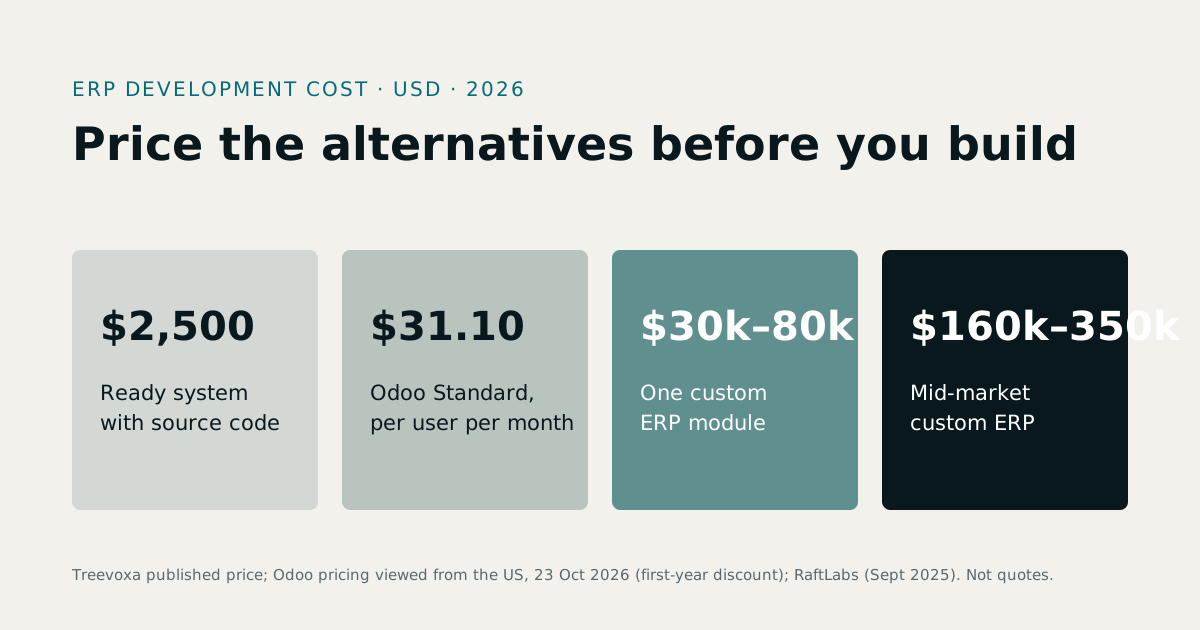
How much does a custom ERP cost for a small business? For a business with roughly 5-50 users, one to three branches and three to six modules, plan on about $18,000 to $110,000 for the build, with most landing between $35,000 and $65,000. That is the planning range we use at Treevoxa for custom ERP software development, in USD. It is a model, not a quote. Published figures run from about $15,000 to $250,000 because the sources define "small" differently, and this guide shows how to place yourself in the range.
The worked budget, the five-year comparison and the payback example below are illustrative models with stated assumptions. They are not client project records or vendor quotes. Change the assumptions to match your business and the answer moves with them.
1How much does a custom ERP cost for a small business?
"Small" has to be defined before any price means anything. This guide is about custom ERP for small business buyers, not enterprise rollouts, and uses:
- Users: 5 to 50 named users.
- Branches: one to three sites, warehouses or outlets.
- Modules: three to six, from inventory, sales, purchasing, accounting, HR and payroll, and production.
Here are the three planning tiers:
| Tier | Users | Branches | Modules | Planning price (USD) | Typical timeline |
|---|---|---|---|---|---|
| Core operational | 5-15 | 1 | 3-4 | $18,000-$35,000 | 3-4 months |
| Multi-branch | 15-35 | 2-3 | 4-6 | $35,000-$65,000 | 5-7 months |
| Advanced, with integrations | 30-50 | 2-3 | 5-6 plus integrations | $65,000-$110,000 | 7-10 months |
Currency: all figures are in USD. Quotes in GBP, AED, AUD or SGD will not be a simple conversion, because exchange rates move and some developers price in local currency. Ask for the currency to be fixed in the contract.
2Why do published ERP prices disagree so much?
Published guides disagree widely. One puts a core operational system at $15,000 to $30,000. Others put small business at $30,000 to $50,000, $40,000 to $100,000 or $50,000 to $250,000. The low and high ends differ by a factor of five or more.
The gap comes from differences in scope, not from one side being right:
| What changes the number | Typical effect |
|---|---|
| What "small" means (5 users or 50, one site or five) | In our experience, can move the price by 2x or more |
| Number and depth of modules | Each extra module adds weeks of build and testing |
| Developer location | One published example shows $225,000 at US rates against under $70,000 offshore, more than 3x |
| Fixed price or time and materials | A fixed price usually carries a margin for the vendor's risk; open-ended billing moves that risk to you |
| Data migration and training included or not | About 6% and 3% of the pre-contingency subtotal in the worked budget below |
| Built from scratch or from a proven base | Changes the hours on core modules (see below) |
When you compare two quotes, check these six items first. Most gaps between quotes come from them. For the wider picture, see our ERP development cost guide and the general custom software development cost guide.
3What do you get at each price tier?
Each tier leaves things out, so here is what to expect.
| Core operational | Multi-branch | Advanced | |
|---|---|---|---|
| Users | 5-15 | 15-35 | 30-50 |
| Branches | 1 | 2-3 | 2-3 |
| Modules | Inventory, sales, purchasing, basic accounting | Adds production or HR, branch-level stock and permissions | Adds payroll, advanced reporting, approvals |
| Integrations | None or one (e.g. payment gateway) | One or two | Several: e-commerce, biometric devices, banks, APIs |
| Price (USD) | $18,000-$35,000 | $35,000-$65,000 | $65,000-$110,000 |
| Timeline | 3-4 months | 5-7 months | 7-10 months |
| What it leaves out | Multi-site stock transfers, deep reporting | Complex integrations, heavy custom workflows | More than 50 users, more than three branches, multi-company consolidation and multi-currency accounting; these are quoted separately |
Pick your tier with five questions:
- How many people will log in on a normal day, not just in total?
- How many places hold stock or take orders?
- Which of inventory, sales, purchasing, accounting, HR and production do you need in the first release?
- Which other systems must connect (a website, payment provider, attendance devices, bank feeds)?
- Do you have clean data to import, or are you starting from messy spreadsheets?
For a personalised number, run your answers through the software development cost calculator.
4What drives the price of a custom ERP?
Modules are the biggest driver. Inventory and sales are usually the cheapest to build well. Accounting and production (bills of materials, batch costing, wastage) take longer because the rules are stricter and the edge cases multiply.
The other drivers, in rough order of impact:
- User roles. A warehouse operative, a branch manager and a finance controller each need different screens and permissions. Ten roles cost more than three.
- Integrations. Payment gateways, e-commerce stores and biometric attendance devices each need building, testing and maintaining.
- Data migration. Cleaning and importing customers, products, opening stock and balances is often underestimated.
- Reporting. Standard reports are cheap. Custom dashboards and management accounts are not.
- Customisation depth. Adapting your exact workflow costs more than fitting a standard one.
- Compliance. VAT or GST handling and e-invoicing add scope. Rules differ by country and change over time, so confirm them with HMRC in the UK, the UAE Federal Tax Authority, the Australian Taxation Office or IRAS in Singapore, not with a vendor blog. Tell your developer which regime applies before scoping.
More background is in our guides.
5What does a worked budget look like?
This is an illustrative model for a 25-user, two-branch manufacturer or distributor. The assumptions:
- A blended rate of $40 an hour. This is a modelling figure, not a quote. Check the software development rates page for how pricing actually works.
- The core modules start from tested code rather than a blank page. If they were written from scratch, the core build hours would be higher, so ask any developer to price both ways.
- One month of go-live support and a 10% contingency.
| Line | Hours | Cost (USD) |
|---|---|---|
| Discovery and scoping | 80 | $3,200 |
| Core build: inventory, sales, purchasing, accounting, roles | 650 | $26,000 |
| Production and bills of materials | 200 | $8,000 |
| Integrations (payments, barcode scanners, web orders) | 120 | $4,800 |
| Reporting and dashboards | 80 | $3,200 |
| Data migration | 80 | $3,200 |
| Testing and acceptance | 120 | $4,800 |
| Training | 40 | $1,600 |
| Go-live support (first month) | 60 | $2,400 |
| Subtotal | 1,430 | $57,200 |
| Contingency (10%) | $5,720 | |
| Total | $62,920 |
That sits in the multi-branch tier. Have a developer test the lines against your real processes before you rely on any of them.
6What hidden and ongoing costs should you budget for?
ERP implementation cost is more than the build invoice. For running costs, this guide assumes 15% of the build price per year for maintenance, bug fixes, security updates and small changes, with hosting on top. That 15% is a modelling assumption drawn from the author's experience, not a published benchmark. Quotes vary, so get the figure in writing.
| Item | Typical annual cost | Who pays |
|---|---|---|
| Hosting and backups | $1,200-$3,600 | You (cloud account in your name is best) |
| Maintenance and bug fixes | About 15% of build cost (assumption) | You, as a support agreement |
| Security and dependency updates | Included in maintenance | You |
| Change requests | Agreed hourly rate or fixed quote | You |
| Refresher training for new staff | A few hours a year | You |
| Support hours beyond the agreement | Hourly | You |
Ask every vendor what the first year after go-live costs and what is covered. This is where the real total cost of ownership shows up.
7Is custom ERP cheaper than Odoo or ERPNext over five years?
It depends on the number of users. For teams under about 10 with standard processes, off-the-shelf ERP often wins.
Licences are the swing factor. This guide does not treat any figure here as a current vendor price. Odoo and ERPNext change their plans, hosting terms and regional prices, so check their own pricing pages. One pricing directory lists SAP Business One from $95 per user per month, which shows how wide per-user pricing can be.
The five-year model below is for 25 users, with these assumptions:
- Custom column: the $62,920 worked budget, hosting at $2,400 a year, and maintenance at 15% of build ($9,438 a year).
- Off-the-shelf column: a $30 per user per month licence (a placeholder), a $25,000 implementation partner, $15,000 of customisation and $3,000 a year of support. The licence is assumed to include vendor hosting.
| Cost (USD, 5 years) | Custom ERP | Off-the-shelf ERP |
|---|---|---|
| Build or implementation | $62,920 | $25,000 |
| Customisation | Included in build | $15,000 |
| Licences (25 users x $30 x 60 months) | $0 | $45,000 |
| Hosting | $12,000 | Included in licence (assumed) |
| Support and maintenance | $47,190 | $15,000 |
| Total | $122,110 | $100,000 |
At 25 users and these assumptions, off-the-shelf is cheaper by about $22,000. Licences grow with headcount and the custom running costs do not, so the break-even is the point where licences close the gap:
Break-even users = (custom total − off-the-shelf fixed costs) ÷ (licence price × 60 months)
The off-the-shelf fixed costs are $25,000 + $15,000 + $15,000 = $55,000, so the top line is $122,110 − $55,000 = $67,110.
| Licence per user per month | Divisor (price x 60) | Break-even users |
|---|---|---|
| $20 | 1,200 | About 56 |
| $30 | 1,800 | About 37 |
| $50 | 3,000 | About 22 |
At $50 a user, 25 users is already past break-even and custom is cheaper. At $20, break-even sits above 50 users, and a 56-user system would cost more than the $62,920 modelled, so custom would not win on price within the small business range.
These figures also assume your off-the-shelf customisation stays at $15,000. If your processes need heavy adaptation, that number rises and the break-even moves down. The case for custom is process fit, not a cheaper sticker price. If your workflow is unusual, customising a standard package can cost as much as building the right thing.
For a fuller comparison, see custom ERP vs Odoo vs ERPNext and our Odoo development page if a package is the better fit. The wider buy-or-build question is covered in custom software vs SaaS.
8How does starting from proven systems cut the cost?
Most of an ERP is not unique: stock movements, purchase orders, invoices, user roles, audit trails. Writing them from scratch for every client is the part you should not pay for.
Treevoxa runs its own products, including Batchbook manufacturing ERP for production and stock, and RE-ERP for property. Where a custom project overlaps with one of them, we can start from that tested code instead of a blank page. That lowers the hours on core modules and the risk of unfinished edge cases. Where a project does not overlap with any product, the build is closer to from scratch and the price should reflect that.
Where a relevant product exists, you can see a working demo before you commit. Whoever shows you one, check:
- A stock movement from purchase order to receipt to sale, end to end.
- Different user roles seeing different screens.
- Reports you actually use, such as stock valuation and aged debtors.
- An audit trail showing who changed what.
- Your own sample data, not a polished demo dataset.
If a full custom build is more than you need, ready-made software with source code is the cheaper route. You buy a running system, own the code and adapt it as you grow.
9Does where your developer is based change the price?
Yes, by a lot. For a 1,500-hour project, the arithmetic is simple. These rates are illustrative bands, not quotes:
| Illustrative blended rate | 1,500-hour project |
|---|---|
| $40/hour | $60,000 |
| $80/hour | $120,000 |
| $120/hour | $180,000 |
| $150/hour | $225,000 |
Offshore teams typically sit in the lowest band and the US in the highest. The UK, Australia, Singapore and the UAE usually fall between, varying by agency size and seniority. See our software development rates for how we price.
The trade-offs are real. A team in another time zone means fewer live conversations. Communication habits matter more than location, and so does ownership: you should hold the code, the hosting accounts and the documentation. For more on how that works, see offshore software development.
10Can you build an ERP in phases to spread the cost?
Yes, and for most small businesses it is the sensible way. Start with the module that hurts most, whether that is stock, sales or payroll, and add the rest later. This sample plan splits the $62,920 example. Each phase carries its share of the budget lines above plus 10% contingency.
| Phase | Scope | Cost (USD) | Timeline |
|---|---|---|---|
| 1 | Discovery, core stock, sales, purchasing and accounting for both branches, migration, training, go-live support, half of testing | $42,680 | Months 1-5 |
| 2 | Production and bills of materials, reporting | $13,640 | Months 7-9 |
| 3 | Integrations (payments, barcode scanners, web orders) | $6,600 | Months 10-11 |
Phase 1 goes live in about five months, inside the four-to-eight-month window small projects typically need for a first release. Built back to back, the whole system fits the multi-branch tier's 5-7 months. The phased plan runs to about 11 months because it leaves a month or so of live use between phases to learn from real users. Phasing can add some overhead for repeated testing and deployment, so keep the contingency. The approach is the one we use in MVP development: ship the useful core, learn, then extend.
On contract type: fixed-price phases suit well-defined scope and make budgets predictable. Time and materials suit evolving requirements but need a cap and regular reporting. Either way, agree in writing how change requests are handled, with a short estimate and your approval before work starts.
11How long does it take and when does it pay back?
Timelines follow the tiers: three to four months for core operational, five to seven for multi-branch, seven to ten for advanced. Migration and user testing are what usually stretch them.
Payback depends on your numbers. Here is a model with explicit assumptions for the 25-user example. It does not include a ramp-up period, so year one would likely be weaker.
| Item | Assumption | Annual (USD) |
|---|---|---|
| Staff time saved | 30 hours a week across the business, 48 weeks, $15 an hour loaded cost | $21,600 |
| Stock errors reduced | 25% less of $40,000 a year in write-offs and miscounts | $10,000 |
| Gross benefit | $31,600 | |
| Running cost | Maintenance $9,438 plus hosting $2,400 | -$11,838 |
| Net annual benefit | $19,762 |
On $62,920 of build cost, payback is about 3.2 years. If the assumptions hold, the five-year net is about $35,900 ($19,762 x 5 − $62,920). That is a positive return but not a fast one. If your real gross savings are below the roughly $11,800 a year it costs to run, the system never pays back on cost alone, and the case has to rest on control, speed or growth. Results vary widely, so do not accept a vendor's ROI promise without seeing the assumptions.
12What protects you from overspending?
Use this checklist before you sign anything:
- A written scope that lists modules, user roles and integrations.
- Fixed-price phases, or a capped time-and-materials budget.
- Source code ownership agreed in the contract, with the code in your repository. Without it, you are renting.
- A working demo before commitment, using your sample data, where a relevant product exists.
- Acceptance tests written up front, so "done" has a definition.
- Documented handover: architecture notes, deployment steps, admin guides.
- Post-launch support terms: response times, included hours, hourly rates.
If you are unsure how to scope, software consulting can produce a requirements document before you ask anyone to price a build.
13How do you get an accurate quote for a small business ERP?
An accurate quote needs more than "we need an ERP". Prepare these before you talk to developers:
- A list of your main processes (order to cash, purchase to pay, production, payroll).
- Your user roles and how many people sit in each.
- Current spreadsheets or systems, with a sample of each.
- Integrations you need, such as payment providers, e-commerce or attendance devices.
- Branches, warehouses and any inter-branch stock movements.
- The reports management uses today, and the ones you wish you had.
- Your tax regime and any e-invoicing obligations.
14So how much should a small business budget for a custom ERP?
How much does a custom ERP cost for a small business? Expect roughly $35,000 to $65,000 for most, with the full range running from $18,000 to $110,000. Below about 10 users, or with standard processes, off-the-shelf ERP is often cheaper. Above that, the answer depends on how well your processes fit a package.