
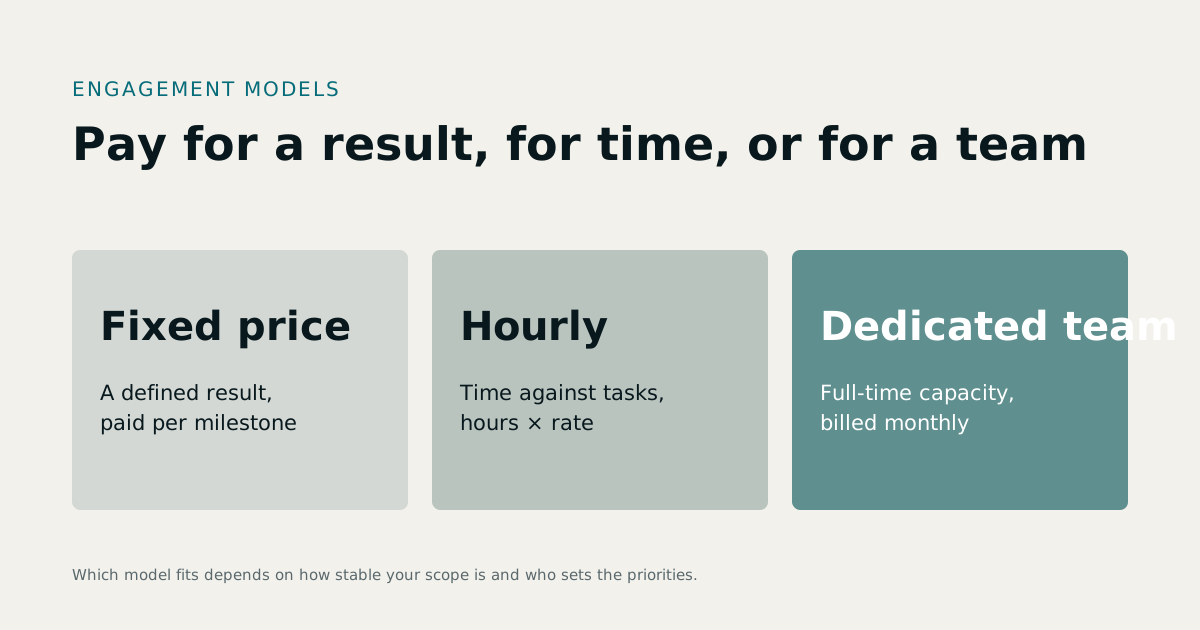
Dedicated team vs freelance developer comes down to how long the software has to live. Hire a freelancer for short, bounded work with a clear finish line. If you are building a system you will run for years, such as an ERP, a CRM or a POS, hire dedicated developers.
Rule of thumb:
- Under about six weeks, one skill, one clear deliverable: freelancer.
- Six months or more, several skills, changes every month: dedicated developers.
- Somewhere in between: a dedicated core, with a freelancer for a specialist burst.
Updated October 2026.
1What is the difference between a freelancer and a dedicated team?
A freelance developer is one person, paid per hour or per task. Most have several clients at once. You find them directly or through a marketplace such as Upwork or Toptal. You brief them, review their work and decide what happens when they are busy or ill.
Dedicated developers work only on your product. They keep a fixed daily overlap with your working hours, and a lead covers absences, so a sick day does not stop the project. The commercial side is usually a monthly fee rather than an hourly meter.
"A team" does not have to mean ten people. In practice it ranges from:
- A small setup: one developer, a part-time tester and a lead who reviews the work. This suits a focused product with one main stream of change.
- A fuller squad: a project manager, a designer, two or three developers and QA. This suits an ERP rollout or a SaaS product with several modules at once.
What matters is not headcount. Someone other than the developer checks the work, and someone else can pick it up tomorrow.
2When is a freelance developer the right choice?
Often. Many articles on this question are written by team vendors, us included, so here is the plain version.
A freelancer is the right answer when:
- The job is small and well defined: a landing page, a bug fix, a one-off integration, a data export.
- You want a prototype to test an idea before committing real money.
- You need a niche skill for a few weeks, such as a payment gateway integration or a specific charting library.
- The software will not change much afterwards.
- You or someone on your staff can write a clear brief and review the result.
For this kind of work a good freelancer will often beat a team on speed and price. There is no onboarding, no project manager and no minimum commitment.
The trade-offs are real. There is one person, so there is one point of failure. Nobody tests their work but them. If they take another client, your project slows down. Everything they learn about your business leaves with them.
If your job fits the list above, hire the freelancer and move on.
3When does a dedicated team become essential?
When the software is part of how the business runs and will keep changing.
Think of a pharmacy POS that must work every morning when the shutters go up. Or a gym system that controls door access and billing. Or a factory ERP that tracks batches and gate passes. These need:
- Several skills at once: design, back end, front end and testing. One freelancer rarely covers all four well.
- Continuous change: new reports, new tax rules, new branches. The work never really ends.
- Someone accountable when it breaks: downtime costs money every hour.
- Memory: the people who know why a rule was built a certain way should still be there in year two.
For the mechanics, see how the dedicated development team model works. This article stays on the freelancer comparison.
4Dedicated team vs freelance developer: which is cheaper?
On the hourly rate, usually the freelancer. On total cost for a six-month product build, often not. The freelancer vs dedicated team question is really hourly price against total cost.
For market ranges, Arc's employer blog publishes 2026 freelance estimates of roughly $30–60 an hour for junior developers, $60–110 for mid-level and $100–180 for senior. Empat's comparison quotes Toptal at roughly $60–200+ and Upwork at roughly $10–150, and a team vendor wrote it. These are other people's figures, as published on those pages, so check them there for the current numbers. Our own figures are on Treevoxa's software development rates page.
Below is a worked model for one full-time developer over six months (26 weeks). We sell the team model, so treat the team column as assumptions rather than a promise, and swap in your own numbers.
Assumptions:
- 160 hours a month, so 960 hours in total.
- A mid-level freelancer at $85 an hour, the midpoint of Arc's mid range.
- Your own time valued at $75 an hour.
- You spend 6 hours a week managing a freelancer and 3 hours a week with a dedicated team.
- Rework adds 10% to freelance hours.
- For the team, 16 hours of your time go on onboarding, and out-of-scope changes add 5% to the fee.
- In the exit scenario, the freelancer leaves at month three.
These are planning assumptions from our own experience, not measured results.
| Line | Freelancer (mid, $85/hr) | Dedicated developers |
|---|---|---|
| Fee for 960 hours | 960 × $85 = $81,600 | Monthly fee from the rates page × 6 |
| Out-of-scope changes | Inside the hourly total | Assumed 5% of the fee |
| Platform fee | Not included; check the platform's current fee page (none if you hire direct) | None, unless you hired through a marketplace |
| Your management time | 156 hrs × $75 = $11,700 | 78 hrs × $75 = $5,850 |
| Your onboarding time | Counted in management time | 16 hrs × $75 = $1,200 |
| Rework from unclear specs | 96 hrs × $85 = $8,160 | Not priced; fixes to agreed scope sit inside the fee |
| Bug fixes after release | 20 hrs × $85 = $1,700 | Fixes to agreed scope sit inside the fee |
| Subtotal | $103,160 | Fee × 6.3 + $7,050 |
| Exit at month 3: your time to find and brief a replacement | 20 hrs × $75 = $1,500 | Lead reassigns; assume a small handover cost, not zero |
| Exit at month 3: replacement spends two weeks learning the code | 80 hrs × $85 = $6,800 | n/a |
| Subtotal with that exit | $111,460 | Fee × 6.3 + $7,050 |
The exit rows price only what you pay for. We assumed six weeks to find and brief a replacement. That is our planning figure, not a measured one. The delay itself costs you calendar time on top of the invoice, and the table does not price it.
Here is the break-even. The team column works out as monthly fee × 6.3 + $7,050, so the monthly fee at which the team costs the same is (freelancer total − $7,050) ÷ 6.3.
| Scenario | Freelancer total | Team monthly fee at which the team costs the same |
|---|---|---|
| $85/hr, no exit | $103,160 | about $15,250 |
| $85/hr, exit at month 3 | $111,460 | about $16,600 |
| $60/hr, no exit | $76,260 | about $11,000 |
The $60 row uses the same method. Items that scale with the rate are the fee, rework, bug fixes and replacement catch-up: 960 × $60 = $57,600, plus $11,700 of your time, $5,760 of rework and $1,200 of bug fixes. Your own time does not scale with the rate.
So a team quoted below those monthly fees is cheaper on total cost, and one quoted above them is not. If a good freelancer is at the lower end of the range, the team has to justify its extra cost on cover, testing and continuity, not on price.
The model also compares equal hours. A team may deliver more or less per hour than one freelancer, and real teams need review time from you too. Many freelancers cannot give 160 hours a month because they have other clients. If yours gives you 80, the build takes twice as long, and that calendar cost is yours.
Use the software cost calculator for a first budget, then run your own numbers through the table above.
What are the hidden costs of hiring a freelancer?
Most of them are your time and your delays, not invoices.
- Briefing and review. Someone must explain the business and check each delivery. We plan for about 6 hours a week for a non-technical owner. Yours may be higher or lower.
- Rework from unclear specs. A freelancer builds what you wrote, not what you meant. Ten per cent extra is our planning figure.
- The replacement gap. Finding and briefing someone new takes weeks, not days. We plan for four to eight.
- Platform fees. Marketplaces take a fee or a margin one way or another, and the terms change. We have not put percentages in the model. Read the fee page on the day you hire.
- No testing. Nobody reviews the code, so bugs reach your staff or customers.
- No cover. Holidays and illness stop the work, and you may not hear in advance.
A simple formula you can run:
True freelance cost = hours × rate + (weekly management hours × weeks × your hourly cost) + (hours × rework % × rate) + platform fee + replacement cost
As our own rule of thumb, if the result is within 15 to 20 per cent of a team quote, the team is usually the safer buy.
5What happens if your freelancer disappears?
This is the most underestimated risk in the whole decision, and it is the one the cost table cannot show.
Picture a gym system. Door access reads member records through a device integration the freelancer wrote. They take a full-time job. Nobody else knows how the sync works. Two months later a firmware update breaks it, and members cannot get in.
Or a pharmacy POS, where an error in stock deduction only shows up at month-end. The person who understood the logic is gone.
With a team, the lead knows the codebase because they review every change. If one developer is off, another covers.
You can reduce the risk either way:
- Keep the repository in your own account, with the freelancer as a collaborator.
- Write a short README and update it with each release: how to run it, how it deploys, what talks to what.
- Keep credentials and hosting in your name, in a password manager you control.
- Ask for short written notes after each piece of work.
- For anything that runs every day, name a second person who has seen the code, even if only for review.
If you do only one thing from this article, make it the first item. A freelancer who resists it is telling you something.
6Who owns the code, and who can fix it on Monday morning?
Two separate questions, and both belong in the contract.
Ownership. Do not assume the code is yours. Who owns custom code depends on the contract and on local law, and the rules differ by country. Get a clause that assigns all rights in the work to you, ideally on payment. Then check the practical side:
- Repository in your account, not theirs.
- Hosting, domain and cloud accounts registered to your company.
- Third-party licences and API keys in your name.
- Written documentation and a handover checklist: how to build, deploy, restore from backup, and where each credential lives.
- A list of open-source components used and their licences.
If you would rather own working software from day one, ready-made software with source code is another route.
Monday morning. When a bug stops your staff at 9 a.m., who answers? Agree a response time in writing, with a named person and a named backup. A freelancer can agree to this, but they are one person, and a Monday outage can land on a day they are busy elsewhere. A team can commit to a response window because it has people to cover it.
Contractor status. Whether someone counts as a contractor or an employee differs by country. Examples are IR35 in the UK and the contractor-versus-employee tests in the US and Australia. Similar questions arise in the UAE and Singapore. The rules affect tax and liability, and getting them wrong can be expensive. We have not quoted any figures. Check current guidance from the official tax and labour authorities in your country, such as HMRC on GOV.UK, the IRS, the US Department of Labor or the Australian Taxation Office, or take professional advice before you sign with an individual.
7Do time zones and overlap hours matter?
Yes. A poor overlap costs you slow decisions, not slow typing.
A freelancer replies when they are online. A dedicated team agrees a fixed overlap inside your working hours, with a daily stand-up at a set time and an agreed response window for urgent issues. That turns "when will I hear back?" into a number.
How much the team has to shift depends on where it sits. The table assumes a team in South Asia or the Gulf, and the gaps change with daylight saving, so check a time-zone converter for your own dates.
| Your location | Practical approach | What to agree |
|---|---|---|
| US | The gap to South Asia and the Gulf is large, so the team shifts part of its day to cover your morning. That means late hours for them, so ask how it is staffed and whether it is sustainable | Stand-up time in your local zone, same-day answer on blocked work |
| UK | The gap is a few hours, so your morning and early afternoon overlap with the team's working day | Stand-up in your morning, response time for urgent bugs |
| UAE | The gap to South Asia is small, so most of the working day overlaps | Which days are working days, since weekends differ by country and employer; stand-up time |
| Australia | The gap is the widest of the five, so overlap tends to fall in your late afternoon, or the team starts early | Stand-up in your late afternoon, written handover note at the end of their day |
| Singapore | Overlap tends to fall in your afternoon | Fixed stand-up, written daily summary |
Ask for the overlap in hours, in your local time, written into the agreement. For how this works in practice, see offshore software development, or the pages on software development for UK companies and software development for US companies. There are similar pages for UAE, Australian and Singapore companies. Canadian readers can also see our guide to hiring offshore developers for Canadian businesses.
8Can you use both: a hybrid model?
Yes, and for many businesses it is the sensible answer.
The pattern: a dedicated core owns the product, and a freelancer comes in for a specialist burst. Examples are a design sprint before a rebuild, a data migration from an old system, or a security review before launch.
Four rules make it work:
- One lead owns the repository. Nobody else merges.
- Freelancers work through pull requests. The core team reviews every change before it goes in.
- One shared spec. The freelancer works from the same written scope as everyone else.
- A clean exit. At the end of the burst, the freelancer hands over notes and loses access.
Without these rules, a hybrid model becomes two people editing the same code with different ideas.
9Which is better for an MVP?
It depends on what the MVP is for.
If it is a throwaway prototype to show investors or test demand, a good freelancer can build it quickly and cheaply. Accept that you may discard the code.
If it is a first release that real customers will use and that must grow, it needs structure: someone testing, someone reviewing, and documentation. That is where a small team pays back. See MVP development for how we scope this, and the custom software development cost guide for budgets.
10How do you choose? A decision table
| Situation | Better fit | Why |
|---|---|---|
| One-off bug fix | Freelancer | Small, bounded, no ongoing need |
| Landing page | Freelancer | One skill, easy to review |
| Six-month product build | Dedicated developers | Several skills, testing, continuity |
| ERP rollout | Dedicated developers | Many modules, constant change, daily dependence |
| Ongoing roadmap | Dedicated developers | Knowledge builds up and stays |
| Urgent start this week | Freelancer, then move to a team | Fastest to begin; plan the handover early |
| No one to manage the work | Dedicated developers | A lead and project manager carry the load |
| Regulated or sensitive data | Dedicated developers | Access control, review and audit trail matter |
A short scorecard. Give one point for each "yes":
- Will the software be in use for more than a year?
- Does it need more than one skill (design, back end, front end, testing)?
- Will you ask for changes every month?
- Would a day of downtime cost you real money?
- Do you lack someone technical to review the work?
- Does it handle customer, patient or financial data?
- Do you need a fixed daily overlap with your own working hours?
- Will you want to add developers later?
0–2: freelancer. 3–5: a hybrid, or a small team. 6–8: dedicated developers.
11What should you check before you hire either?
- Written scope. One page of what is in and what is out. For ways of working, see software development methodologies.
- Code in your account. Repository, hosting, domain, keys.
- A named backup person, not just a promise.
- Response times for urgent bugs, in writing.
- Test and release process. Who tests, and how a release reaches production.
- Payment tied to milestones, not only to hours.
- Handover documents delivered before the final payment.
- Exit terms. Notice period, what is handed over, and who helps.
- A reference call with a past client whose software is still running.
If you are unsure whether your scope is right, software consulting can give you a second opinion before you commit money.
12So which should you hire?
For a dedicated team vs freelance developer decision, start with how long the software has to live. Freelancers suit small, clear jobs. A dedicated team suits software your business depends on, and a hybrid covers the middle. Then run the cost table with your own hours and rates, and check the break-even against the quotes you receive. More background is in our guides and custom software development services.