
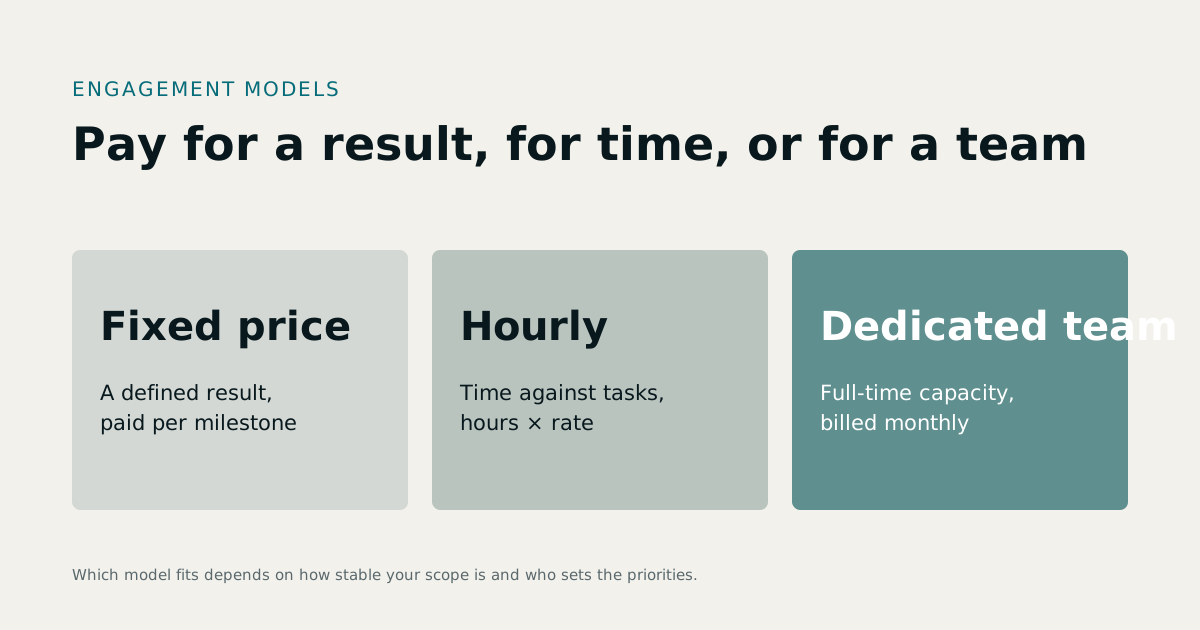
If you want to hire dedicated React developers, you are paying for one engineer who works only on your product, overlaps with your working day and is billed monthly. Across the sources we reviewed, published prices run from roughly $1,500 to $15,000 a month depending on region, seniority and what the price includes. The all-in cost is higher than the headline fee (worked through below). The model fits when you have a continuing product, enough roadmap to keep one person busy for about 20 hours a week or more, and someone on your side who can give direction.
In the search results I looked at, most pages are vendor landing pages, and few show real prices or admit where the model doesn't fit. This guide covers what the rates are, why the sources disagree, what to check before you sign, and when to choose something else. It is written from delivery experience.
1What does it mean to hire dedicated React developers?
“Dedicated” should mean three things. If a vendor can't confirm all three in writing, you're buying something looser.
- One person, your product only. They don't split days between your project and three others.
- Daily overlap in your hours. You agree a window, say four hours, when they are online, in stand-up and answering messages.
- Billed monthly, not per task. You pay for their time and attention. Output depends on how well you direct them.
This is the dedicated development team model scaled down to one person. You get continuity: after three months they know your codebase, your users and your odd edge cases. You also carry the management load. You decide what gets built and in what order, unless you buy a vendor-managed arrangement, which costs more.
A dedicated React developer is not a freelancer hired by the hour. Nor are they an agency team, where several people share your project and a project manager sits between you.
2What does a dedicated React developer actually do?
On a web product, a dedicated React developer builds and maintains the interface: screens, forms, tables, dashboards, data fetching and the state behind them. The skills that matter in practice are:
- Hooks and component design. Small, clean components and effects that don't cause infinite loops.
- TypeScript. For a product you'll maintain for years, I'd treat it as the default.
- State management. Knowing when local state, context, a query library or a global store is the right tool. Overusing global state is a common sign of a weak developer.
- Testing. Component tests and a few end-to-end checks on the flows that make money.
- Performance. Avoiding needless re-renders, splitting bundles and keeping large lists fast.
- Design systems. Reusable components, so the tenth screen takes a fraction of the time the first one did.
Do you need React only, or Next.js and full-stack skills?
Plain React gives you a front end that talks to an API. Next.js adds server rendering, routing and better search visibility, so it suits public sites and content-heavy products. For a logged-in business tool such as a dashboard or admin panel, plain React is often enough. Our React development and Next.js development pages explain where each fits.
Whether you need full-stack skills depends on who owns the API. If you already have a backend team, a front-end specialist is right. If not, you need someone who can build the server side too, usually with Node.js development. Don't assume one person is strong at both. Ask for examples of each.
Do you need a mid, senior or lead developer?
A mid-level developer can build well-defined features with review. A senior can take a vague problem, choose an approach and defend it. Hire a lead only when you need someone to set architecture and mentor others, which in practice means you have a team.
For a first dedicated hire with no in-house engineer, senior is usually the safer choice. A mid-level developer with nobody technical to review the work tends to drift.
One person or a small team?
One developer is right for a defined front end with a stable API. Add a second person, or a part-time designer or tester, when you need design, backend and front end moving together. A single developer is also a single point of failure, which I cover under what goes wrong.
3How much does it cost to hire React developers in 2026?
Search for "hire react developers" or "react developer cost 2026" and you'll find quotes that differ by roughly ten times. They describe different things: a freelancer's hourly rate, a vendor's monthly invoice, a US employee's salary. Treat them as ranges to test against, not as a price list. For wider context, see our custom software development cost guide.
What is the typical React developer hourly rate by region?
These are third-party figures, checked 26 Oct 2026. They are not the market rate, and they will have moved by the time you read this. A dash means the source didn't report that figure.
| Region | Hourly | Monthly |
|---|---|---|
| US / Canada | $60–$150+ (CommercePundit) | $8,000–$15,000 (Techvoot) |
| Western Europe | $50–$120 (CommercePundit) | $6,000–$12,000 (Techvoot) |
| Eastern Europe | $30–$80 (CommercePundit) | $3,500–$7,500 (Techvoot) |
| LATAM, India and SE Asia (combined) | $20–$50 (CommercePundit) | – |
| India and South Asia | $10–$35 (Techvoot) | $1,600–$4,900 (Techvoot) |
| UK freelancers | £40–£70, or £300–£550 a day (Fulminous Software) | – |
Some detail beneath those headline figures:
- Techformation splits India by seniority: junior $10–$15, mid $15–$25 and senior $25–$35 an hour.
- CommercePundit gives a freelance marketplace average of $51–$75 an hour, with a median of about $63.
- Fulminous quotes US freelancers at $60–$120 an hour and a dedicated developer at $1,500–$2,500 a month. Rocket Systems says $90–$150 for US freelancers and $15–$50 an hour for staff augmentation.
For our own figures, see Treevoxa's development rates. I won't quote competitors' prices as if they were ours.
Why do the published rates disagree?
Mostly because the numbers aren't measuring the same thing:
- Seniority. A $15 an hour mid-level and a $35 an hour senior are both “India”.
- Overlap hours. A developer who works your evenings costs more than one who doesn't.
- Platform fees and margins. A marketplace adds its cut on top of the developer's pay. CommercePundit reports Toptal at roughly $80–$220+ an hour, Lemon.io at $60–$120 and Arc from about $30. Check each vendor's own site, because their pricing changes often.
- Freelancer versus vendor. A freelancer's rate carries no cover for sickness, replacement or management. A vendor's rate usually does.
- What's included. Some quotes cover QA, a delivery lead and tools. Others are the bare developer.
A $1,500 monthly quote and a $12,000 one can both be honest. They are selling different products. Ask what's inside before you compare.
What does a dedicated developer cost per month, all in?
The headline fee is rarely the real cost. This table is illustrative. The figures are my assumptions for a mid-to-senior developer hired through an offshore vendor, not published prices. Swap in your own.
| Line | Monthly (illustrative) | Notes |
|---|---|---|
| Developer fee | $3,500 | The number on the quote |
| Your management time | $1,500 | About 6 hours a week from a product manager or CTO, valued at roughly $58 an hour |
| Onboarding, spread over 6 months | $250 | Setup, walkthroughs, early reviews |
| QA share | $500 | A quarter of a tester |
| DevOps or design share | $600 | Deployments, environments, UI input |
| Tools and licences | $100 | Repositories, CI, design tools, monitoring |
| Replacement risk allowance | $200 | Handover time if the developer leaves |
| Total | about $6,650 | Nearly double the headline fee |
For comparison, Rocket Systems puts a US full-time React developer at $140k–$200k+ plus 25–35% in benefits, with 2–4 months to recruit. My own arithmetic on those figures gives at least $14,600–$22,500 a month ($140k × 1.25 ÷ 12 and $200k × 1.35 ÷ 12). That is an illustration for the US only. It is a floor, because the salary figure is “$200k+”, and it excludes recruitment costs.
It isn't a like-for-like comparison either. An employee brings team context, and a dedicated hire brings flexibility. But the gap is real, which is why people look offshore. To size your own project, try the software cost calculator.
4Is a dedicated developer better than a freelancer or agency?
It depends on your situation. Staff augmentation means a vendor supplies engineers who work under your direction, and a dedicated developer is the most common form of it. The speed-to-start figures below are typical ranges from our experience, not published benchmarks.
| Dedicated developer | Freelancer | Agency | In-house | |
|---|---|---|---|---|
| Cost | Mid; monthly | Low to mid; hourly | Highest per unit of output | Highest all-in |
| Speed to start | Days to two weeks | Days | One to four weeks | Months |
| Management load | High: you direct | High: you direct | Low: they manage | High: you manage |
| Continuity | Good, with replacement terms | Weak: they may leave when busy | Good, but staff can rotate | Best |
| Accountability | Vendor and developer | The individual only | The agency, for outcomes | Employment contract and line management |
| Best for | Ongoing product work | Short, defined tasks | Fixed-scope builds | Core product at scale |
The trade-offs I'd flag:
- Freelancers are great for a two-week task and risky as your only engineer. If they get a bigger contract, your product stalls.
- Agencies take the management off you, and you pay for that. They suit a project with a clear scope and end date.
- Dedicated gives you control and continuity at lower cost than in-house, but only if you can supply direction.
- In-house is right when the product is the business and you can afford the months it takes to hire.
Many teams combine them, such as one in-house technical lead with dedicated developers offshore. Our page on offshore software development covers how that works day to day.
5When is a dedicated React developer the wrong choice?
Sometimes it isn't the right model. Skip it if:
- The work is a short, one-off project. Three months of defined work is a fixed-scope build, not a hire.
- The scope is unclear. A dedicated developer will build whatever you ask. If you don't know what to ask for, you'll burn monthly fees finding out. Start with MVP development or software consulting to find the right shape.
- There's less than about 20 hours a week of work. Below that, you're paying for idle time, or the vendor is quietly splitting the developer across clients, which is no longer dedicated.
- Nobody can give direction. If no one on your side can set priorities and review work, you need a managed team.
- You need design, backend and front end together. One React developer won't cover it. A web application development engagement with a full team is the better route.
6How do you vet a React developer?
Ignore “top 1%” claims. They are marketing, and the test behind them is rarely published. Run your own short screen:
- Review real code. Ask for a repository or a sample they can share. Look at component size, naming, types and tests.
- Run a 60-minute paired task. Give them a small real problem, such as a filterable table with an API call, and watch how they think. How they handle being stuck matters more than whether they finish.
- Ask a few pointed questions.
- What causes a component to re-render, and how do you stop needless renders?
- When would you use context, a query library or a global store?
- What goes wrong with
useEffect, and how do you avoid it? - How would you speed up a slow list of 10,000 rows?
- What do you test, and what don't you?
- How do you use TypeScript to prevent bugs rather than just satisfy the compiler?
- Ask for a trial period. Two to four weeks with an exit and no penalty is reasonable. Agree it before you start, not after the first problem.
Red flags: they can't explain their own past decisions, they have never written tests, they're vague about what they built versus what the team built, or they get defensive when you question an answer.
If someone isn't a good fit, a good vendor replaces them quickly. Put that in the contract, not in a sales call.
7How much timezone overlap will you get?
Agree a daily overlap window in your hours, in writing. A common arrangement is four hours of shared time plus a response-time promise outside it. Use that window for stand-up, code review slots and unblocking questions, and keep the rest of the day for heads-down work.
How much overlap you get depends on where the developer sits. As an illustration, assume a developer in India (UTC+5:30) working 10:00 to 19:00 local time, against a 9:00 to 18:00 day at your end. This is an assumption for the sums, not a statement about any vendor.
- UAE (UTC+4, no clock changes): about eight hours in common. See software development for UAE companies.
- UK: roughly four and a half hours in winter and five and a half in summer, mostly your morning. See software development for UK companies.
- Singapore (UTC+8): about five and a half hours, in the developer's afternoon and yours. See software development for Singapore companies.
- Australia (Sydney and Melbourne): about two and a half to three and a half hours, depending on daylight saving, in your afternoon and the developer's morning. See software development for Australian companies.
- US east coast: almost none on a normal day. The developer has to shift to a late schedule, for example 15:00 to midnight India time, to get four to five hours. Agree this up front, and expect it to affect price. See software development for US companies.
Clocks change on different dates in different countries, so the window can move by an hour for a few weeks each year. A developer in Eastern Europe or Latin America changes the picture entirely, so check the maths for your own city.
8Who owns the code, and what terms should you ask for?
This is contract advice, not legal advice. Take legal advice for your own jurisdiction before you sign. The points I'd want covered:
- IP assignment to you. Everything written for you belongs to your company, stated in the contract, not assumed.
- NDA. Signed before the developer sees your code or data.
- Repository in your account. Your GitHub or GitLab organisation, with the developer invited in. Never the other way round.
- Access control. Named accounts, least privilege, and a plan to revoke access on the day someone leaves.
- Notice period. One month is common. Check it applies to both sides.
- Replacement terms. How quickly the vendor must supply a replacement, and who pays for the handover.
- Exclusivity. If you're paying for dedicated, the contract should say the developer works only on your product.
9What should the first 30 days look like?
Start with a scoping checklist, then a week-by-week plan.
| Scoping item | What to settle |
|---|---|
| Goal | What the product must do in the next 90 days |
| Stack | React version, TypeScript, state tool, Next.js or not |
| Backend | Who owns the API, and whether it is documented |
| Design | Figma files or a component library, and who maintains them |
| Definition of done | Reviewed, tested, deployed to staging |
| Overlap window | Hours, stand-up time, response times |
| Reporting | Weekly demo, written updates |
- Week 1: access and setup. Repositories, environments, accounts and a walkthrough of the codebase. The developer runs the app locally and reads the docs.
- Week 2: a small first ticket. Pick something low-risk and real, such as a bug fix or a small feature. You're testing communication and review rhythm as much as code.
- Week 3: build the rhythm. Daily stand-up, pull requests reviewed within a day, and a written definition of done applied to every ticket.
- Week 4: first release. Ship something to production, however small. Hold a short review: what worked, what slowed you down, and whether to continue.
10What goes wrong, and how do you handle it?
These are the problems I see most often, and how to catch them early:
- Missed deadlines. Usually caused by unclear requirements rather than laziness. Break work into tickets small enough to finish in two or three days, so slippage shows quickly.
- Bus factor of one. If only one person understands the code, you're exposed. Insist on documentation, readable commits and a second pair of eyes on reviews.
- Unclear requirements. Write scope down. A two-paragraph ticket with acceptance criteria prevents most arguments.
- Quality drift. Pull requests get bigger and tests disappear. Keep the review standard from week one.
- Mismatch. The developer is technically fine but wrong for you. Use the trial period and replace early.
The best early warning is a weekly demo of working software, not a status report. For the underlying causes, read our guide to technical challenges in software development, or choose a delivery approach using our software development methodologies guide.
How fast can a dedicated React developer start?
Realistically, days to two weeks for matching, interviews and onboarding. In-house recruitment takes months: Rocket Systems quotes 2–4 months in the US. Be wary of “top 1% developers in 24 hours” claims, such as the one in Techformation's headline. A fast match is possible. A fast match that you've properly screened is rarer. Take the extra week and run your own technical screen.
11Should you hire dedicated React developers?
Hire dedicated React developers when you have ongoing product work, at least about 20 hours a week of it, and someone who can set priorities and review the output. Budget for the all-in cost, not the headline fee. Get IP assignment and replacement terms in writing, and run your own technical screen with a trial period. If the work is short or the scope is vague, a freelancer, an agency or a scoping phase will serve you better.
Written by Syed Muhammad Ashhad, CEO and lead software engineer at Treevoxa, from delivery experience.