
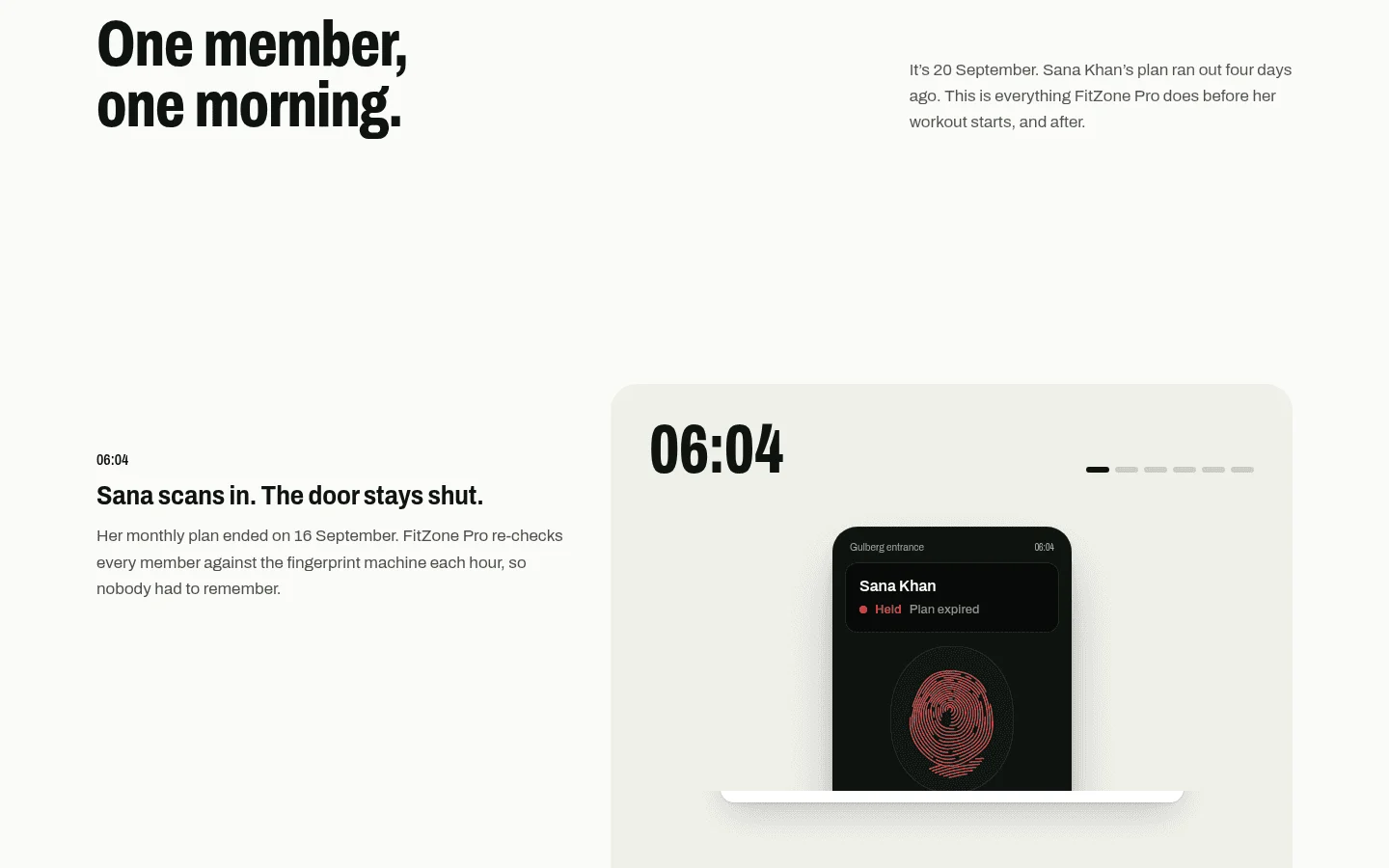
Yes. You can stop a member with an expired gym membership or a failed payment from walking through the door. Knowing how to block gym members with expired fees at the door is less about hardware than policy, because the door is the result of your rule, not the rule itself. Write the rule first: tie entry to billing status, put the grace period and notice dates in writing, and only then decide how the door enforces it. This guide sets out a full policy for a single-site gym with no turnstile. If you later want a system to enforce it, ask us how FitZone Pro gym management software handles door access and billing for your setup. Think of gym access control as the last step, not the first.
Most of the advice online comes from gym software vendors. It is useful on the mechanism: tie access to billing, allow a short grace period, show a clear denial message, and restore access once payment clears. It says less about what an owner needs before anything is switched on: a written policy, a script for the front desk, a check of the law, and a plan for a gym with one door. For GTA gyms, the Ontario points below need checking first. For US gyms, the New York and Illinois points matter most.
1Can you block gym members with expired fees at the door?
Yes, if three things are true. The rule is linked to billing status, not to someone's memory at the desk. The rule is written down before anyone enforces it. And every member gets the same treatment.
If any of those is missing, the door becomes a source of arguments. A front-desk worker who waves through one lapsed member because they like them has broken the rule for everyone else. The next lockout will be harder to explain.
Write the rule first, then pick the method. A single-site studio in Denver with a staffed desk can run a workable version on a printed list. A larger or multi-site operation, such as a two-branch gym in Austin, needs a system that updates the door automatically. Either way, the rule exists before the door does anything.
2What door rule should your gym write down first?
Write one timeline and put it in your membership contract. The example below assumes gym membership fees are due monthly, with a three-day grace period.
| Day | What happens | What the member sees |
|---|---|---|
| Day 0: due date | Payment is taken. If it fails, a retry is scheduled and written notice goes out the same day. | Email or text saying the payment failed and how to fix it |
| Day 2 | Second retry. Reminder sent. | Second reminder with a payment link |
| Day 3 | Final reminder. Grace period ends at the end of the day. | Notice that entry stops tomorrow |
| Day 4 | Entry is paused for the unpaid account. | Denial message and member prompt at the door |
| Any day after payment clears | Access restores once the payment is confirmed. | The door opens at the next check-in |
In this example, entry is paused from day 4, the day after the three-day grace period ends. Use that same rule in every document, screen and conversation.
The notice date matters as much as the lockout date. Put both in writing. A clause like this works:
“If a membership payment fails, we will notify you in writing on the day it fails. Entry is paused from the fourth day after the due date, once the three-day grace period has ended, unless payment has been received.”
That gives you a written grace period and notice date you can point to if a member disputes a lockout. The same timeline applies to an expired gym membership that is not renewed. The membership end date simply replaces the due date.
The restore rule should be one sentence too: access returns once payment is confirmed, and no staff action is needed. Any manual override should be logged with a name and a reason.
How long should the grace period be?
Common choices are one to three days. Some vendor sequences run seven to 14 days with several reminders, which suits businesses whose members are likely to fix a card problem quickly.
The trade-off is simple. An immediate lockout recovers the most revenue, but it hits members whose card expired last week or whose bank flagged a payment. Those members are often loyal. A longer grace period keeps them, but it costs you money on members who were never going to pay.
Late fees are your call. Decide whether to charge one, set an amount that your state or province allows, and write it into the contract. Check the limits where you operate before you set the figure.
What must the membership contract say?
The contract needs three things: the access rule, the notice you give, and how access is restored. Keep the wording plain. For example: “Entry may be paused if a membership payment is not made by the end of the grace period. You will be notified in writing when a payment fails. Access is restored when payment is received.”
Before you add that clause, check the cancellation and contract rules where you operate. A lockout clause can collide with a member's right to cancel. The legal section below lists what to check. This is not legal advice, so take the clause to a lawyer who works with gyms.
3How do you stop a member at the door without a turnstile?
You do not need a turnstile to enforce a rule. You do need a method the front desk can rely on, and the choice depends on how many doors you run and how many staff are on shift. Gym door access can be as simple as a checked list or as automatic as a linked controller.
| Method | Stops entry automatically | Needs hardware | Consent needed | Best for |
|---|---|---|---|---|
| Daily expired-member list checked at the desk | No. Staff check each entry | No. A printed or tablet list is enough | Covered by your contract notice | Single-site gyms with a staffed desk |
| Card or QR check-in that staff can see | Only if the software shows status at check-in. Test it | A phone, tablet or scanner | Covered by your contract notice | Small studios where staff are always present |
| Staff stop at the gate until the member speaks to someone | No. It depends on a person | No | Covered by your contract notice | Owners who want a human check before entry |
| Turnstile or door controller linked to billing | Yes, once linked and tested | Yes | Depends on the credential type | Multi-site gyms and busy doors |
The manual options are slower and depend on discipline. The first time the front desk gets a rush, the list gets ignored. Build the list check into the opening and closing routine, and name one person who owns it.
If you use a check-in screen, ask what it shows. Some systems display a member's name but not billing status, so staff must look it up. That can work for a small gym, but test it with a lapsed account before you rely on it. A staff stop at the gate only works if the member is asked to step to the desk, not held in the doorway.
Ask every vendor whether the system tells you when a member is denied at the door, who receives that alert, and whether the denial is logged. Get the answer in writing before you buy.
4Does fingerprint entry need written consent in Illinois?
Yes. In Illinois, a business must give written notice and get written consent before it collects a fingerprint or face scan. Biometric entry changes the consent paperwork you keep. It does not change the blocking rule. A member whose fees have lapsed should be blocked whether they use a finger, a face or a card. For how biometric check-ins connect to fees, read linking biometric attendance to gym membership fees.
| Credential | What you store | Consent and notice | Hygiene | Typical hardware cost |
|---|---|---|---|---|
| Fingerprint | A biometric template | Strict in Illinois. Written notice and consent before collection | Members touch a shared sensor | Higher |
| Face | A biometric template | Strict in Illinois. Written notice and consent required | Touchless | Higher |
| Card or fob | A card or fob number | Standard contract notice | Touchless when tapped | Lower |
| QR code | A link to the member's app account | Standard contract notice | Touchless when scanned from a phone | Usually lower, if members use their own phones |
The rule in Illinois comes from the Biometric Information Privacy Act (740 ILCS 14). The statute has been amended, and secondary guides describe its damages differently, so check the current text with a lawyer. Do not rely on any penalty figure from this article or from a vendor page.
Other states have their own rules, and this section covers only Illinois. If you operate in more than one state, confirm each one before you choose a credential.
Keep signed consent on file before the first scan, and make it a condition of enrolment. If a member refuses to consent, offer a card, fob or QR option instead. If you are comparing face systems, see our buyer's guide to gym software with face recognition entry.
5What should happen when a payment fails?
Use a retry-then-lockout sequence, and treat two types of decline differently.
Soft declines are temporary: insufficient funds, a network fault, or a bank check. Retry them on a schedule. Hard declines mean the card cannot be used: it is closed, reported lost, or the number is wrong. Retrying the same card wastes time and annoys the member. Ask for new details instead.
Your failed payment gym access rule should have three parts: retry soft declines on your schedule, send a notice on the day of any decline, and pause entry only after the grace period ends.
How quickly should door access be revoked after a failed payment?
In the timeline above, the member hears about the failure on the day it happens, and entry pauses on day 4, after the three-day grace period. Shorter or longer grace periods move that date, but the written notice always comes first. Access should not be revoked before the grace period you have written down has ended.
Should I lock out a member immediately when a payment fails?
Usually not. One declined charge is often a card problem, not a decision to leave. Immediate lockout is the fastest way to lose a member who would have paid.
Vendors publish recovery figures for failed payments. We have not used them here, because the figures are not independently checked. Ask for the method behind any number before you use it to set your policy. Your own records from the first three months will tell you more than a generic percentage.
6What should front-desk staff say when access is refused?
Keep the message short and warm, and let the screen or sign carry it. The staff member should not explain the debt, argue about it, or stand in the doorway.
The denial message on the screen should read: “Entry is paused on your account. Update your payment details at the link below.” The member prompt is a QR code or short link to the payment page, with “Ask at reception if you need help” underneath.
If the member asks the desk, the script is something like:
“I'm sorry, entry is paused on your account today. You can update your payment with the link on the screen, and entry will open again once the payment clears. Would you like help finding the link?”
Staff should not say the amount owed in front of other members, call the account overdue, or ask the member to step aside for a talk. If the member wants to dispute the charge, send them to the manager once the queue clears, and give them the manager's contact details.
No staff member should confront the member at the door. If the member pushes back, offer the manager's contact, log the visit, and move on. The system did the blocking. The desk only explains it.
7How fast should access come back after a payment clears?
Access should return automatically once the payment is confirmed. The member should not need to call anyone, and staff should not have to reset the profile by hand.
Expect a short delay while the payment confirms with the bank. Tell members that at the desk. If a card has been updated but the payment has not yet cleared, the account may still show as paused for a while.
Ask any vendor for the restore timing in writing, and test it on a lapsed account before you go live. The timing depends on your setup and your payment provider, so do not take a generic figure from a sales page.
Manual overrides are where rules leak. Any time staff open a door for a paused member, log who did it, when, and why. Review the log weekly. If the same person keeps overriding, you have a training problem or a rule that needs changing.
8What happens to entry if the internet drops?
A door controller can keep a local copy of the member list. If the connection drops, it may keep checking entries against that copy, so members can still get in. How that works depends on the hardware and how it is set up.
That means you must decide before installation what the door does when the connection is lost. There are two options:
- Stays open. Members keep coming in, and a lapsed member may get through during the outage.
- Stays locked. Nobody gets in, including members who have paid, so you risk complaints and lost sessions.
Write the decision down and put it in the contract or the staff handbook. Do not let the installer make the choice by default.
Any door that is also an exit must still meet your local fire and building rules. Check with your inspector before you lock or limit it. Then ask the vendor how the terminal behaves offline, and test it on a quiet morning before you rely on it.
9Are there legal limits on locking out a member?
Yes. Gym contracts sit under consumer law, and a lockout can conflict with a member's right to cancel. Take the points below to a lawyer before you switch the rule on.
| Area | What to confirm | Why it matters for a lockout |
|---|---|---|
| Ontario | The cancellation and refund rules for prepaid gym contracts. The province's guidance on joining a gym or fitness club is a starting point. Ontario now has a Consumer Protection Act, 2023, so confirm which version applies to a contract you sign today | A lockout clause must not stop a member from cancelling properly |
| New York | Whether the cancellation rules for monthly memberships apply to your contract, and how long the cancellation window is. The Attorney General has taken action against a Queens gym over refunds and misleading customers | A no-entry rule must not block a valid cancellation |
| Illinois | Written notice and written consent before collecting fingerprints or face scans, under 740 ILCS 14. Check the current statute for damages | Biometric entry needs consent records before the first scan |
| Every state and province | Late fee limits, and how a lockout clause sits alongside your contract | A lockout is only fair if the contract allows it |
A lockout clause should never stop a member from cancelling properly. If someone cancels inside a cancellation window, the door should not be the thing that prevents it. Build a manual exception path for cancellations into your process, and log every one.
Can a gym block entry after a member cancels?
Once a cancellation is valid and the membership has ended, entry can stop on the end date. Until then, the normal grace period rules apply. In New York, for example, a monthly member who cancels inside the window should keep access until the cancellation takes effect. Confirm the window with a lawyer before you block anyone during a cancellation period.
10How does one door rule work across several branches?
If you run more than one site, a member can pay at one branch and walk into another. One rule set should apply everywhere, or members will learn where the gap is.
Ask these questions before you buy:
- Who sets the rule: head office or each branch?
- Can a branch manager override it, and who can see that?
- How does a member's status follow them from one site to another?
- What does the door at a second branch show for a member from elsewhere?
FitZone Pro's ZKTeco gym software page describes the terminal integration. Ask us what it does for your billing rule, and get the answer for a second branch in writing before you rely on it.
Keep one written policy for all sites. Put the timeline, grace period, notice dates and denial message in one document, and have every branch use the same text.
11What mistakes stop a lockout from working?
Most failures are small and avoidable. Watch for these:
- Assuming a debt flag stops the door. On some systems, marking a member as blacklisted does not block entry. Test it with a test account before you rely on it.
- Missing paused memberships. An expired gym membership that has been paused rather than ended can still show as active, or the reverse. Check how freezes are handled in your rule.
- Ignoring bank stop-payments. A member who stopped a payment with their bank may dispute the charge. Keep a record of every notice you sent, so you can show the timeline.
- Letting overrides undo the rule. A friendly desk override, repeated often enough, becomes the rule. Log every one.
- Forgetting the collection side. A lockout only gets money back if the member pays. For the follow-up once a member is blocked, see our guide to gym dues recovery.
12What should you check before you switch the rule on?
Work through this list before the first lockout, and name one owner for each line.
| Check | Owner | Done |
|---|---|---|
| Contract wording covers the access rule, notice and restore | Owner | ☐ |
| Written notice sent to all current members | Manager | ☐ |
| Grace period and notice date set in the system | Operations lead | ☐ |
| Denial message and member prompt tested on a lapsed account | Operations lead | ☐ |
| Front-desk script trained and practised with staff | Front-desk lead | ☐ |
| Offline behaviour decided and written down | Owner | ☐ |
| Consent records in place for any biometric entry | Owner | ☐ |
| Test with a staff account, including restore after payment | Manager | ☐ |
Switch the rule on for new failures first. Then apply it to the backlog, so members who lapsed before the change get a clear notice rather than a surprise. Run it for a month, then review the denials, the overrides and the complaints.
In short, knowing how to block gym members with expired fees at the door is a policy job before it is a hardware job. Tie entry to billing, give written notice, pause access only after the grace period, and treat every member the same. Then test it on a lapsed account and review the denials and overrides after the first month.