
A manufacturing ERP with batch tracking gives every material receipt and every production run its own batch record, then links those records from the supplier's lot through production to finished goods and the customers who received them. It is the kind of system we build as custom ERP software, and we run one ourselves, the Batchbook manufacturing ERP. The test is simple: can you go from a customer complaint back to a raw-material lot, and from a lot forward to every customer? If the batch is only a text box, the answer is no.
This guide is for owners and operations leads at small and mid-size factories who are shortlisting ERP. It covers what to require, how to test a vendor in a demo, which route to take and what each route roughly costs.
1What is a manufacturing ERP with batch tracking?
It is an ERP where the batch is a real object in the database, not a note typed on a form.
When raw material arrives, the system creates a batch record with the supplier's lot number. When you issue that material to production, it records which batch went into which run. When the run finishes, the output gets its own batch number, linked back to everything consumed. When you ship, the dispatch line carries the batch.
That chain turns a recall into a report instead of a week of searching paper and spreadsheets.
It matters most where product is mixed, cooked, blended, filled or cured: food, chemicals, cosmetics, plastics compounds, supplements. It also matters in mixed factories that make some items by discrete assembly and others by batch. Those are the hardest to fit into packages designed for one model or the other.
2Batch tracking vs lot tracking: which do you need?
In everyday factory speech, "batch" and "lot" mean the same thing. The difference between batch tracking and lot tracking is mostly vocabulary. Some vendors use "lot" for what a supplier ships to you and "batch" for what you make. We use that convention here.
A serial number is different. It identifies one unit, not a group.
| Batch | Lot | Serial number | |
|---|---|---|---|
| What it identifies | One production run | One supplier shipment or defined quantity | One single unit |
| Typical use | Food, chemicals, cosmetics, plastics | Incoming raw materials and packaging | Machines, devices, electronics |
| Example | 2,000 jars of face cream made on Tuesday | 500 kg of shea butter from one delivery | One pump with its own warranty |
| Cost of tracking | Moderate: one record per run | Low to moderate: one record per receipt | High: one record per unit, scanning at every step |
Use batches and lots for anything made in volume. Add serial numbers only where you need unit-level warranty, service history or regulated device identification.
Mixed factories often need all three. A pump maker might track resin by lot, moulding runs by batch and the finished pump by serial number. Check that any system you shortlist can hold all three on the same item master.
3What must a batch record contain?
Most vendor pages skip this. A batch record is a small set of fields that must all be present and linked. If one is missing, you will feel it during a recall.
| Field | What it holds | Why it matters |
|---|---|---|
| Batch number | Unique ID, generated by the system | The anchor for everything else |
| Supplier lot | The supplier's own lot or batch code | Lets you act on a supplier's recall notice |
| Received date | Date and time of receipt | Ageing, stock rotation, audit |
| Expiry or best-before | Date, with rules for how it is set | FEFO picking, blocking expired stock |
| Quantity and unit | Received, consumed, on hand | Mass balance: what went in must be accounted for |
| Status | Quarantine, released, rejected | Stops unchecked material reaching production |
| Location | Warehouse, bin or line | Finds the stock physically |
| Parent-to-child links | Which input batches made which output batches | The genealogy that powers traceability |
| Cost per batch | Material, labour and overhead rolled into the batch | Real margins and stock valuation |
| Quality results | Test values, pass or fail, certificate of analysis | Evidence that release was justified |
Why status matters more than people expect
Status is the field that turns tracking into control. Material arrives in quarantine. It moves to released only after a quality check. Rejected stock stays visible but cannot be issued.
If your ERP lets the store pick quarantined stock onto a production order, the batch record is decoration. Ask the vendor to try it in the demo.
How does forward and backward traceability work?
Tracing means following the parent-to-child links in two directions. Here is a worked example for a cosmetics maker.
One lot of shea butter, SUP-4471 (500 kg), is received and released. It is used in three finished batches, which ship to five customers.
| Finished batch | Shea butter used | Shipped to |
|---|---|---|
| B-1001 | 120 kg | Customers A, B |
| B-1002 | 180 kg | Customers B, C, D |
| B-1003 | 150 kg | Customers D, E |
Forward trace (the supplier says lot SUP-4471 is contaminated): the system starts at the lot, finds B-1001, B-1002 and B-1003, then lists customers A to E. It should also show the 50 kg not yet used, which is either on the shelf, written off as waste or a gap in your records.
Backward trace (customer D complains about B-1002): the system starts at the batch and lists every input, including SUP-4471 and the other lots in the recipe. It should also show that B-1003, which also went to customer D, shares that lot.
That web of parents and children is the batch genealogy. A good system draws it for you. A weak one makes you assemble it from three separate reports.
Does it handle expiry and FEFO picking?
It should. FEFO means first-expired, first-out. The system suggests or enforces picking the batch that expires soonest, not the one that arrived first. FIFO rotates by receipt date and can leave short-dated stock behind.
For factories this matters on short-life raw materials and on finished goods where retailers demand a minimum remaining life. Pharmacies use the same logic for medicines, as we explain in our guide to FEFO inventory for pharmacies. Also ask whether the system blocks expired stock from being issued or only warns about it. Warnings get clicked through.
4What else should a batch-tracking ERP do?
Traceability sits on top of ordinary manufacturing basics. If the basics are weak, the genealogy will be too.
- Recipes and BOMs with versions. You need to know which formula version made batch B-1002. Editing a recipe in place and losing the old one breaks the audit trail.
- Quality checks at receipt and in process. Sampling plans, pass or fail results and holds, tied to the batch rather than kept in a separate spreadsheet.
- Certificates of analysis. Store the supplier's certificate against the lot, and produce your own for customers who ask.
- Barcode or QR scanning. Scanning on receipt, issue and dispatch removes manual lot entry, which is where many errors start.
- Yield and by-product costing. If 1,000 kg of input gives 940 kg of product and 30 kg of saleable by-product, cost has to be split sensibly. This is the same logic as any accounting and costing software build: the cost follows the batch. Our guide to product costing for factories covers materials, overhead and FIFO batches.
- Production planning. Planning against real stock, including what is on hold in quarantine.
Goods movement is where batch numbers usually get lost. A truck leaves the gate and nobody records which batch is on it. In Batchbook, the QR code gate pass is our answer to that gap: the movement out of the factory is tied to the stock record instead of a paper slip.
5How do you run a mock recall in a demo?
A feature list tells you what a vendor says the system does. A mock recall shows what it does. Run it on every system you shortlist, with your own sample data if you can.
- Set the scene. Ask the vendor to load a dataset with at least two or three levels: supplier lots, intermediate batches and finished batches, shipped to several customers.
- Pick a finished batch. Choose it yourself, not one the vendor suggests. Ask for every customer who received it, with quantities and dispatch dates.
- Pick a supplier lot. Choose a raw-material lot used in more than one batch. Ask for every finished batch it touched and every customer those batches reached.
- Add a twist. Ask what happens if a batch was partly consumed, split across two warehouses or reworked into a new batch.
- Time it. Start a clock when you ask and stop when you have a complete answer.
- Ask for the result as a report. It should export or print as a list you could send to a regulator or customer, not a screen you have to screenshot.
- Check the numbers add up. Quantities received, consumed, shipped and on hand should reconcile. If they don't, ask why.
Vendors often quote recall speed in minutes. Treat those figures as claims until you have seen them on a dataset of your own size. A recall report across 50 batches is not the same test as one across 50,000.
We show a working demo of Batchbook before a client commits, and we are happy to be put through the same test. You can contact Treevoxa to arrange one. If a vendor will not run this scenario, weigh that when you compare.
What are the warning signs of weak batch tracking?
Use this as a scorecard during demos.
| Requirement | Priority | Red flag |
|---|---|---|
| Batch as a real record | Must | Batch is a text box on the transaction |
| Quarantine, released and rejected status | Must | Anyone can issue unreleased stock |
| Link between consumed inputs and output batch | Must | Parent batches are entered by hand afterwards |
| Forward and backward trace in one report | Must | Several reports have to be stitched together |
| Expiry dates with FEFO suggestion | Must | Dates are stored but not used in picking |
| Audit trail of changes | Must | Batch records can be edited silently |
| Recipe versioning | Must | Old formulas are overwritten |
| Allergen flags on items and recipes | Must (food) | No way to report batches by allergen |
| Lot selection by scan on issue | Nice | Lot numbers typed manually on every issue |
| Certificates of analysis stored against lots | Nice | Documents kept outside the system |
| Mass balance report | Nice | Cannot reconcile quantities in against out |
As a rule of thumb from our own work, three or more red flags on the must-have rows suggest "batch" has been added to the screen without being built into the data.
6Should you buy off the shelf or build custom?
Both routes work. The right one depends on how standard your process is.
Packages win when your needs are standard. You make a limited range, follow common recipes and want to be live quickly. SAP Business One, Odoo, Microsoft Business Central with industry add-ons and process-specific ERPs are the sort of options buyers shortlist. That list is illustrative, not a ranking. We have not tested them for this article and have not priced them, and features change between versions. Run the mock recall on each instead of trusting a feature list.
Custom wins in a few clear cases:
- Your process is unusual: co-products, rework loops, or blends that don't fit a standard recipe model.
- You run mixed discrete and batch production, and packages make you choose one model.
- Local rules, multi-currency, or tax and labelling quirks need building around.
- Per-user fees would climb as you grow, and you would rather own the system.
Custom starts slower and needs a partner you trust to maintain it. There is a middle route too: ready-made software with source code, where you start from a working system and adapt it.
For a fuller side-by-side, read our custom ERP vs Odoo vs ERPNext comparison.
7What does a manufacturing ERP with batch tracking cost?
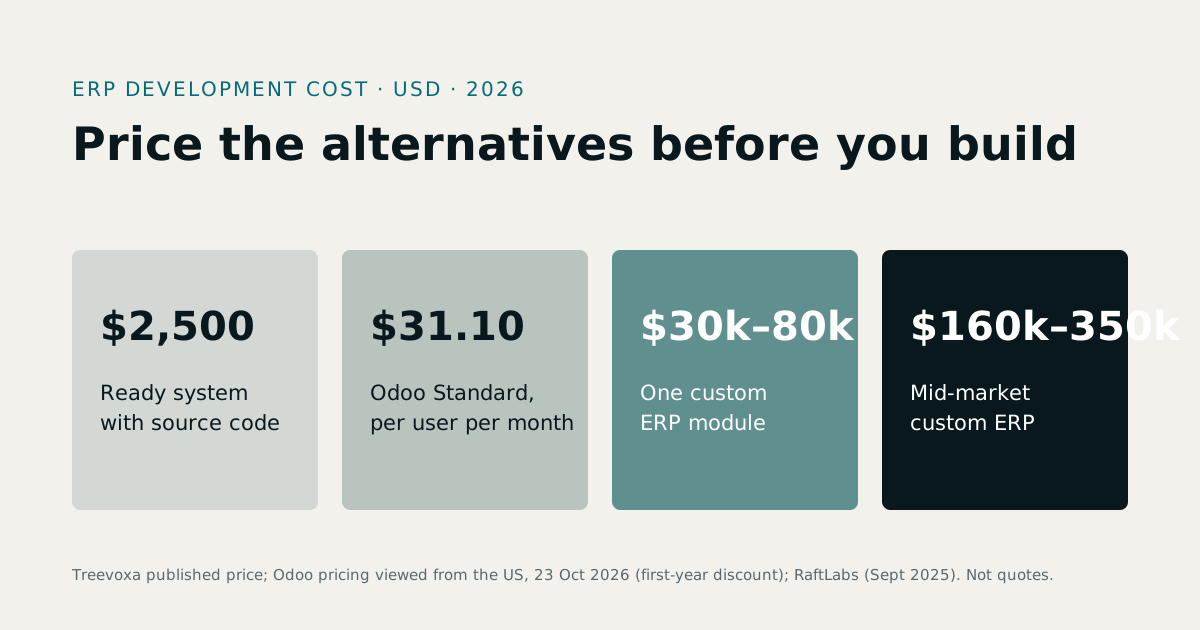
The cost of batch traceability software varies widely. The table below is our own planning estimate in USD, based on the kind of projects we scope. It is not a quote and not a price list for any named product. The assumptions: about 25 users, one site, a few integrations (accounting, barcode scanners), per-user pricing for packages and no major data-migration surprises.
| Route | Licence or subscription (5 years) | Implementation | Customisation | Typical 5-year total |
|---|---|---|---|---|
| Configured package (general ERP) | $40k–$150k | $15k–$60k | $5k–$30k | $60k–$240k |
| Process-specific ERP | $75k–$250k | $25k–$80k | $5k–$30k | $105k–$360k |
| Custom build | None, you own the code | Included in build | $60k–$180k to build | $100k–$280k, including $8k–$20k a year for support and hosting |
The ranges overlap heavily, so cost alone rarely decides it. Packages usually cost less in year one. What separates the routes is fit and growth: a custom build has no per-seat fee, so it gets relatively cheaper as users are added, while a package gets you running sooner if your process is standard.
Three things push cost up on any route: messy item and supplier data, many integrations and long approval cycles. Developer rates matter for custom work, so see our software development rates and our wider guide to ERP development cost. To size your own project, try the software cost calculator, and check our product pricing for ready-made options.
8Which rules apply to batch records?
This is a short overview, not legal advice. Check the current text with your regulator or a compliance adviser.
- US food, FSMA 204. The FDA's Food Traceability Rule requires Key Data Elements to be recorded at Critical Tracking Events for foods on the Food Traceability List, using Traceability Lot Codes. The FDA extended the compliance date from 20 January 2026. Secondary sources, such as Nulogy's timeline summary and Xenia's rule overview, report the new date as 20 July 2028. We have not checked it against the FDA's own page, so confirm the current status there before you plan around it.
- UK and EU food. The UK Food Standards Agency and the EU General Food Law broadly expect food businesses to identify their suppliers and customers, often described as one step back, one step forward. Check the detail for your product with the regulator.
- GMP, HACCP, BRC and SQF. Good Manufacturing Practice and HACCP underpin most food, cosmetic and pharma audits. Certification schemes such as BRC and SQF typically include traceability checks at audit. Read your scheme's current standard for what it requires.
- Allergens. Your system should flag allergens on items and recipes and report which batches contain them.
- Pharma, 21 CFR Part 11. Electronic records and signatures in US pharma need controls such as audit trails and access control.
For the UAE, Australia and Singapore, local food and product authorities set their own rules. Ask your regulator or auditor what evidence they expect, then write that into your requirements.
9How do you roll it out without stopping production?
Phase it. A phased rollout is slower on paper and much safer on the floor.
- Clean the data first. Merge duplicate items, fix units of measure, tidy supplier records. In our experience, most go-live problems start here.
- Agree batch numbering. Decide the format once (for example plant, date and sequence) and stick to it. Changing it later breaks continuity.
- Pilot one line. Pick a line that is representative but not your largest. Run it live for a few weeks alongside your old process.
- Train the store staff on scanning. The storekeeper and the line operator decide whether your data is accurate. Give them time to practise.
- Run a mock recall before go-live. Use the same test as in the demo, now on your own data. Fix what it reveals, then roll out line by line.
Whichever manufacturing ERP with batch tracking you choose, run the mock recall before you sign.