
If you want to hire a dedicated developer with time zone overlap, agree 3 to 4 shared hours a day, write them into the contract, and pick the region by your own clock rather than the vendor's promise. Treevoxa's dedicated developer hiring page covers how we staff; this guide shows the clock, the cost and the contract wording.
"Dedicated" means the developer works only on your product, not across a pool of clients. "Overlap" means the hours when both sides are online at once.
1How many hours of overlap do you actually need?
The sources disagree, and the disagreement is useful. All of them are vendors or consultancies, so read them as views, not research.
- Full Scale says 3 to 4 hours is enough for most teams.
- match.dev says 4 or more if your style is meeting-heavy.
- Idelsoft says seniors can manage with 2 to 3 hours, while juniors may need 6 or more.
- Acquaintsoft says 1 to 2 hours can work for structured work.
They differ because three things change the answer:
- Seniority. A senior developer unblocks themselves. A junior waits for answers.
- How clear the specification is. Tickets with acceptance criteria need far less live talk than "build something like this".
- How much you rely on meetings. If decisions happen in calls, you need calls. If they happen in written comments, you need less.
So 3 to 4 hours is a sensible default, not a law. Go lower only if your specifications are tight and the developer is senior.
A simple rule: match overlap to role and task
This is Treevoxa's rule of thumb from running its own products. It is not an industry standard.
| Role | Suggested daily overlap | What the overlap is for | What can be async |
|---|---|---|---|
| Junior developer | 5 to 6 hours | Stand-up, questions, pairing, same-day review | Well-defined tickets once the junior is settled |
| Senior developer | 3 to 4 hours | Stand-up, review, design questions, incident cover | Most feature work, written hand-overs |
| Tech lead | 4 hours | Planning, demos, trade-off decisions, mentoring | Documentation, code review, research |
You can also cut it by task.
Needs live time:
- Sprint or weekly planning
- Demos and sign-off
- Production incidents
- Unclear requirements that need back-and-forth
- Onboarding in the first two weeks
Does not need live time:
- Feature work against a clear ticket
- Code review
- Bug fixes with a reproduction
- Writing tests and documentation
- Routine upgrades
If most of your week falls in the second list, 2 to 3 hours is fine. If most of it falls in the first, ask for more.
2Which regions overlap with your working day?
Most pages on this topic are written for US buyers looking at Latin America. Buyers in the UK, UAE, Australia and Singapore get very little, even though South Asia sits well for several of them.
Overlap depends on the developer's agreed shift as much as on geography. Treevoxa's developers are based in Pakistan (PKT, UTC+5), so the table below uses that. A developer in Pakistan or India can overlap with US hours, but only by working very early or very late. For the Gulf, the UK and Singapore, the natural working day already overlaps.
Greatex puts India's natural overlap at 3.5 to 5.5 hours with UK and European business hours, but only 1 to 2 with the US East Coast. That is a figure for India, which is 30 minutes ahead of Pakistan, so treat it as a rough cross-check on our Pakistan table, not proof of it.
What does the overlap look like on the clock?
Basis. The table assumes a developer in Pakistan and a client working 09:00 to 17:00 local time. A standard developer day is 09:00 to 18:00 PKT, and a shifted day is also a 9-hour span including a break. It uses the clocks in force from 1 November 2026 until mid-March 2027: US standard time, UK GMT and Sydney summer time (UTC+11). It covers one developer shift only; breaks are not deducted.
| Client location (offset from PKT) | Standard day: overlap | Shifted day: developer hours (PKT) and overlap |
|---|---|---|
| US Eastern, UTC−5 (10 hours behind) | None. The developer's day ends at 08:00 Eastern. | 14:00 to 23:00 PKT. Overlap 09:00 to 13:00 Eastern = 19:00 to 23:00 PKT. 4 hours. |
| US Pacific, UTC−8 (13 hours behind) | None. The developer's day ends at 05:00 Pacific. | 17:00 to 02:00 PKT. Overlap 09:00 to 13:00 Pacific = 22:00 to 02:00 PKT. 4 hours. |
| UK, UTC+0 (5 hours behind) | 09:00 to 13:00 UK = 14:00 to 18:00 PKT. 4 hours. | 10:00 to 19:00 PKT. Overlap 09:00 to 14:00 UK = 14:00 to 19:00 PKT. 5 hours. |
| UAE, UTC+4 (1 hour behind) | 09:00 to 17:00 UAE = 10:00 to 18:00 PKT. 8 hours. | Not needed. |
| Singapore, UTC+8 (3 hours ahead) | 12:00 to 17:00 Singapore = 09:00 to 14:00 PKT. 5 hours. | 08:00 to 17:00 PKT. Overlap 11:00 to 17:00 Singapore = 08:00 to 14:00 PKT. 6 hours. |
| Sydney, UTC+11 (6 hours ahead) | 15:00 to 17:00 Sydney = 09:00 to 11:00 PKT. 2 hours. | 07:00 to 16:00 PKT. Overlap 13:00 to 17:00 Sydney = 07:00 to 11:00 PKT. 4 hours. |
What this table says:
- UAE and UK buyers get a workable overlap with no change to anyone's day.
- Singapore is comfortable. Starting one hour earlier gives 6 hours.
- Australia is tight on a standard day. Starting two hours earlier gets you to 4 hours.
- The US needs a shifted schedule, and it is a heavy one. For Eastern, the overlap falls in the late evening in Pakistan. For Pacific, it is a night shift. Treevoxa does not advertise a US-hours schedule; for US clients, overlap beyond a short window is something to agree explicitly before you start, and we will say plainly what is realistic.
Clock changes move all of this for a few weeks or months a year. Each example below names the months it applies to:
- UK summer time (UTC+1), late March to late October: the standard-day overlap becomes 5 hours (09:00 to 14:00 UK), because the UK is then 4 hours behind PKT.
- Sydney standard time (UTC+10), early April to early October: the standard-day overlap becomes 3 hours.
- US summer time, mid-March to early November: Eastern is 9 hours behind PKT, so the same 14:00 to 23:00 PKT shift overlaps 5 hours instead of 4.
Dates differ by country, and some Australian states do not change their clocks at all. Confirm the dates for your year in a reliable time-zone tool, and check every row of this table against one before you rely on it.
3Does overlap mean the developer works nights?
Sometimes, and you should know before you sign.
A shifted schedule means early starts or late finishes. The risks are real: fatigue, weaker focus and higher turnover. A tired person at 03:00 does not write careful code, and a developer who resents the schedule may leave within months, taking your product knowledge with them.
A better pattern is a split or staggered day with a fixed core window. The developer is online for your 3 to 4 hours and does focused solo work in their normal waking hours for the rest. That is much easier to sustain than a full night shift.
Ask any vendor:
- Who will work the shifted hours, and did they choose them?
- Is the schedule rotated or permanent?
- What happens if that person leaves?
- Can the developer attend an occasional early or late meeting without the whole schedule moving?
If the answers are vague, the overlap will be too.
4What about public holidays, weekends and daylight saving?
This is where overlap tends to disappear without anyone noticing.
Weekends differ. Saudi Arabia and some other Gulf countries work to a Friday and Saturday weekend. The UAE federal government moved to a Saturday and Sunday weekend in 2022, with a shorter Friday, but private employers set their own, so ask. Offices in Pakistan and India mostly work Monday to Friday, though some firms work Saturdays, and Friday midday is often a longer break in Pakistan. If your week and the developer's week do not line up, you can lose a day of overlap.
Holidays differ. Eid dates depend on the moon and move earlier each year. Pakistan, India, the UAE, Singapore, the US, the UK and Australia all keep different calendars. A three-day Eid break is no surprise if you planned for it, and a crisis if you did not.
Clocks change on different dates. The US, UK and Australia change on different weekends. The UAE, Singapore, Pakistan and India currently do not change their clocks. Confirm this with a reliable time-zone source, because rules can change.
What to do about it:
- Agree a shared holiday calendar for both sides at onboarding, and refresh it every January.
- Require notice of leave. We suggest at least two weeks for planned leave.
- Name a cover person who knows your codebase well enough to handle an urgent fix.
5What does overlap cost? A worked monthly comparison
Hourly rates vary widely. Every third-party figure below is a vendor claim for the region named, not a quote for Pakistan or for your project, so check it before you rely on it.
Empat's 2026 nearshore cost article gives US onshore at $100 to $200 or more an hour, nearshore at $30 to $90, and South and Southeast Asia at $20 to $40. Tecla quotes about $3,500 a month for a senior nearshore developer. The monthly figures are our arithmetic at 160 working hours a month.
| Model | Hourly range (vendor claim) | Approx. monthly at 160 hours | What to watch |
|---|---|---|---|
| US onshore | $100 to $200+ (Empat) | $16,000 to $32,000+ | Best overlap, highest cost |
| Nearshore (Latin America) | $30 to $90 (Empat) | $4,800 to $14,400 | Tecla separately quotes about $3,500 a month for senior staff, which sits below Empat's range. Ask which seniority and what is included. |
| Offshore, standard hours | $20 to $40 (Empat, for South and Southeast Asia as a whole) | $3,200 to $6,400 | Not a Pakistan-specific figure. Overlap depends on your region (see the clock table). |
| Offshore, agreed overlap | No source | Get a written quote | Ask whether shifted hours change the price |
| Treevoxa | See Treevoxa's development rates | Use the rates page | State the overlap hours when you ask for a quote |
Then there is the hidden cost, which is our own view from running projects. A cheaper developer who misses your window can cost more overall. A blocked question that waits a day, a misunderstood ticket that comes back wrong, and a review that slips all add rework and delay. Work out what a lost day costs your business before you choose on rate alone.
For a rough project figure, try our software development cost calculator.
6Dedicated, freelance, in-house or project: which fits?
Each model handles overlap differently.
| Model | Overlap control | Continuity | Cost | Management effort |
|---|---|---|---|---|
| Dedicated developer | High: written into the agreement | High: same person long term | Mid | Medium: you direct the work |
| Freelancer | Low: depends on goodwill | Low: availability changes | Varies | High: you chase and review |
| In-house hire | Highest, but only in your own time zone | High | Highest once salary, tax and equipment are counted | Medium |
| Fixed-price project | Low: the vendor sets hours | Ends with the project | Predictable for a fixed scope | Low if scope is clear |
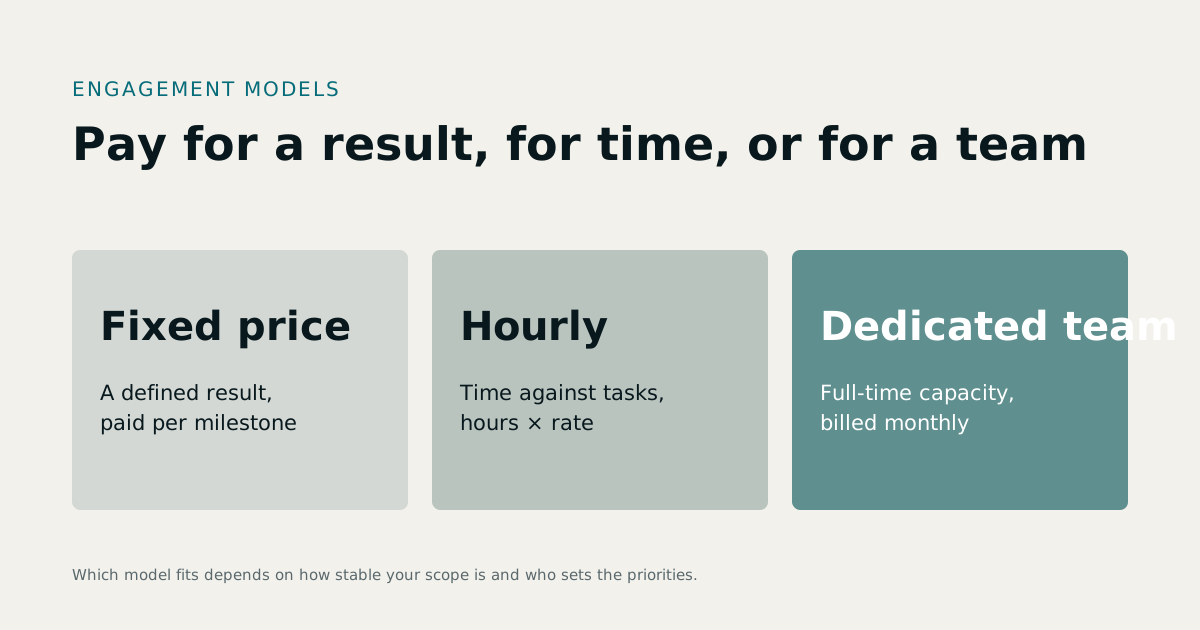
A dedicated developer is the easiest model to hold to an overlap commitment. One named person works to one agreed schedule on your product. A freelancer can disappear for a week, and a project team may rotate people. For more on how the model works and what it costs, read our guide to the dedicated development team model. If you are not sure which model fits, Treevoxa's software consulting can help you decide before you commit.
7What should the overlap clause in the contract say?
Copy this list into your agreement and fill in the blanks.
Core hours
- Core hours of ___ to ___ in your local time, equal to ___ to ___ in the developer's time, Monday to Friday.
- The clock-change rule: whether the contract follows your clock or the developer's when daylight saving changes, and who adjusts.
Response times
- Inside core hours: reply to messages within ___ minutes.
- Outside core hours: reply to non-urgent messages by the start of the next core window.
- Urgent production issues: a named channel and a response target of ___ minutes.
Meetings and escalation
- Which meetings the developer attends: daily stand-up, weekly planning, demo.
- An escalation route if the developer cannot be reached, with a named backup who can act on your codebase.
Leave and holidays
- A shared holiday calendar agreed at onboarding.
- Notice for planned leave of ___ days, and how cover is arranged.
Misses and remedies
- What counts as a miss, for example core hours not kept on more than ___ days in a month.
- The remedy: a fee credit, extra hours made up, or the right to end the agreement.
Trial and replacement
- A trial period of ___ weeks.
- Replacement terms if the developer leaves or does not fit: notice period, hand-over time and who pays. Vendors often advertise trials and free replacement as sales points, so get the terms in writing.
Ownership and data
- Assignment of intellectual property to you.
- How your data is accessed, stored and transferred.
- Confidentiality terms.
Legal points such as GDPR, cross-border data transfer and IP assignment depend on your country and on where the developer is based. Have a lawyer in your jurisdiction check this part. Nothing here, including this checklist, is legal advice.
8How do you run the first month so overlap holds?
A contract does not keep overlap alive. Habits do. For the first month:
- One daily stand-up inside the core window, fifteen minutes, every day.
- A written hand-over note at the end of each developer day: what was done, what is blocked, what is next.
- A single ticket board where everyone sees status, rather than work scattered across chat threads.
- A shared definition of done: tested, reviewed, documented and demonstrated.
- A weekly demo of working software, not slides.
- A monthly review of overlap actually kept, measured against the clause. If it has slipped, fix it then, not at renewal.
Plain async tools are enough: a shared chat channel, a ticket board and short recorded screen walkthroughs. Consistency matters more than which brand you pick. The same goes for your delivery method, whether sprints or something lighter: choose one and keep to it. Our guide to software development methodologies explains which one fits which project.
9How do you hire a dedicated developer with time zone overlap?
Treevoxa's developers are based in Pakistan. We run our own products, including FitZone Pro, PharmaFlow and MatrixHR, so we know what happens when a problem lands outside someone's hours.
- UK, UAE and Singapore: a standard working day already gives a usable overlap, as in the clock table. See software development for UK companies, software development for UAE companies and software development for Singapore companies.
- Australia: a standard day gives a short window, so we agree earlier starts case by case. See software development for Australian companies.
- US: we do not advertise a US-hours schedule. If US overlap matters, raise it at the start and we will tell you what we can agree. See software development for US companies.
In every case, we would rather the core hours, response times and cover were written down than assumed. For the wider picture, see offshore software development. If you want the overlap for your own clock worked out, you can send us your hours through the contact page.
To hire a dedicated developer with time zone overlap that lasts, work from your own clock, agree 3 to 4 core hours, put them in the contract and check them every month.