
Choose staff augmentation when you want to add capacity inside a process you already run well. Choose a dedicated team when you want someone else to own delivery of a product over many months. That is the core of the dedicated team vs staff augmentation decision. Treevoxa's dedicated developers work only on your product, with a daily overlap in your working hours. The rest of this article is the practical version, including the costs and contract points most comparison pages skip.
1Dedicated team vs staff augmentation: which should you pick?
The table below sets the two models side by side.
| Staff augmentation | Dedicated team | |
|---|---|---|
| Who manages the work | You. Your lead assigns tasks and reviews code | The vendor's lead plans and reports against your priorities |
| Typical duration | Weeks to a few months | Six months and up, often years |
| Cost model | Per person, per hour or per day | Monthly fee for a team, usually including a lead |
| Scaling | Quick to add or remove people | Steadier, slower to reshape |
| Onboarding | Fast, but into your setup | Slower start while the team forms |
| Product knowledge | Sits with individuals who may leave | Builds up inside a team that stays together |
| Accountability | Yours. Contractors answer for their tasks | The vendor answers for delivery |
| Best fit | Skill gaps, short overloads, a strong in-house lead | New products, long roadmaps, no technical leadership |
If your answers to these rows point in different directions, the last section of this article gives a tie-break.
2What is the difference between the two models?
Staff augmentation adds individuals to your team and your process. A dedicated team arrives with its own lead and its own way of working, and it is accountable for outcomes.
So is a dedicated team just staff augmentation with more people? No. The difference is ownership, not headcount. Ten augmented contractors are still ten people you must direct. A team of three with a lead who answers for delivery is a different arrangement.
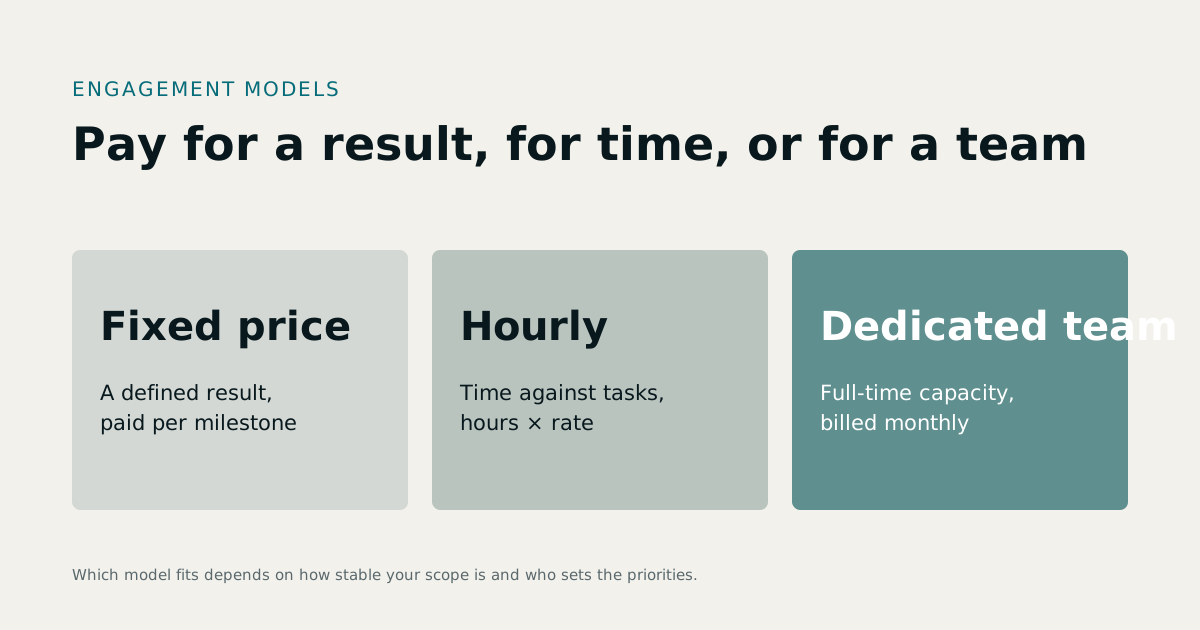
There is a third option: fixed-price project outsourcing. You agree scope and price up front, and the vendor delivers to that scope. It works when requirements are clear and unlikely to move. It works badly when you learn as you build, because every change becomes a negotiation. A dedicated team suits work where priorities shift. A fixed-price project suits work where they should not.
3Who manages the developers and who owns delivery?
Under augmentation, you do. You assign tasks, run the sprint, review the code and decide what "done" means. That is fine if you have a technical lead with spare time. It is a problem if your only technical person is already stretched. If you are unsure how to run the sprints, our guide to software development methodologies is a good place to start.
With a dedicated team, the vendor's lead plans the work, reviews code and reports progress against the priorities you set. You still set direction and accept the work. You do not run the day.
The trade-off is control against load. Augmentation gives you tight control and puts the load on you. A dedicated team gives you less direct control and takes most of the load away.
For planning, we use these assumptions for your own manager's time. They are not measurements, and they vary a lot with the team and the work:
- Augmentation: around 8 to 12 hours a week for a group of three, covering task writing, reviews, unblocking and stand-ups. It grows with headcount.
- Dedicated team: around 3 to 5 hours a week, covering priorities, demos and sign-off. This grows more slowly, because the vendor lead absorbs the day-to-day.
Those hours cost money. The next section prices them.
4Which costs less? A worked example
Per head, augmentation usually looks cheaper. The real question is what it costs once you add your own management time and the cost of people leaving. The table prices the same team under both models, for a short job and a long one.
Every figure is illustrative, in US dollars and rounded for easy arithmetic. They are not quotes and not Treevoxa's rates. The management hours are planning assumptions, and your internal time is priced at $70 an hour. For the dedicated team, the lead is billed at half-time for three engineers and full-time for six.
| 3 engineers, 3 months: augmentation | 3 engineers, 3 months: dedicated | 6 engineers, 18 months: augmentation | 6 engineers, 18 months: dedicated | |
|---|---|---|---|---|
| Person-months | 9 | 9 | 108 | 108 |
| Cost per engineer per month | $4,000 | $4,400 | $4,000 | $4,400 |
| Engineering cost | $36,000 | $39,600 | $432,000 | $475,200 |
| Vendor lead | $0 (you supply one) | $8,250 | $0 (you supply one) | $99,000 |
| Your management time | 130 h = $9,100 | 52 h = $3,640 | 1,560 h = $109,200 | 312 h = $21,840 |
| Replacement and re-onboarding | $3,000 | $1,000 | $9,000 | $2,000 |
| Total | $48,100 | $52,490 | $550,200 | $598,040 |
| Per engineer-month | about $5,340 | about $5,830 | about $5,090 | about $5,540 |
On these inputs, augmentation comes out about 8% cheaper in both cases. The per-head gap is similar, about 9%, so your management time has not closed it.
The result is sensitive to your management load, though. Raise it by half, to 15 hours a week for three engineers and 30 for six. Augmentation then costs $52,650 and $604,800, level with or above the dedicated team. If your lead is expensive or already overloaded, the cheap per-head rate stops being cheap.
The table leaves out rework, delays, and what your manager would have done with those hours instead. Those costs are real and hard to estimate. A dedicated team costs more on paper here. What it buys is a lead who owns delivery, a lighter load on you and a steadier monthly figure.
For real figures, see Treevoxa's development rates. Then put your own team size, duration and management time into the software development cost calculator. Our guide to the dedicated development team model covers how it works and what it costs in more depth, and the wider guides library goes further.
When does staff augmentation win?
Augmentation wins when the gap is narrow and the surroundings are strong:
- A skill gap. You need a Node.js or Flutter specialist for a quarter, not a permanent hire.
- A short overload. A launch is six weeks out and your team is behind.
- A strong in-house lead and sprint process. Someone already knows how to run engineers and has the time.
- Work you can cut off cleanly. A defined integration or a set of reports, with clear acceptance criteria.
Picture two extra developers joining an ERP team that already has its own lead, a backlog and a release routine. They pick up tickets on day two. Nothing about how the team works needs to change. That is augmentation at its best, and it suits a growing business with an existing IT team.
When does a dedicated team win?
A dedicated team wins when the work is large, long or unowned:
- A new product or MVP. Nobody inside the business knows how to shape it yet.
- A long roadmap. Twelve months or more, where continuity matters.
- Several parallel streams. For example, one group on an HR system's payroll module while another handles reporting.
- No internal technical leadership. You need someone to make architecture decisions and answer for them.
- Knowledge that should accumulate. You want the same people to remember why a decision was made.
One example is a full team building a module of an ERP or HR system over a year. The lead plans releases, the engineers learn your processes, and you review demos rather than pull requests. For that kind of work, see our ERP software development and HR software development services. For a first version of a product, see our MVP development service.
5Does time-zone overlap matter?
A daily overlap window matters more than the time zone itself. A two-hour shared window can carry a stand-up, review hand-offs and urgent questions. A team with no shared hours will cost you a day on every question.
Treevoxa's dedicated developers keep a daily overlap in the client's working hours. Agree the window in writing before work starts, and name the city whose clock you mean.
| Client region | What to settle up front |
|---|---|
| US | The US spans several zones, so name the city the window is based on. Most places change clocks, but not all |
| UK | Fix stand-up and review slots in UK hours, and recheck them when the clocks change in spring and autumn |
| UAE | The UAE does not observe daylight saving, so the window stays steady all year |
| Australia | Some states and territories do not observe daylight saving. Those that do change clocks on different dates from the northern hemisphere. Name the city and recheck twice a year |
| Singapore | Singapore does not observe daylight saving, so the window is fixed once you set it |
Use the overlap for stand-ups, review hand-offs and anything that blocks work. Leave the rest of the day for uninterrupted building. For more on this way of working, see our page on offshore software development.
6What should the contract say?
A monthly invoice does not make a managed team. Labels are cheap, so check what the paper commits the vendor to. Use this checklist.
| Clause | What good looks like | Red flag |
|---|---|---|
| Accountability for delivery | The vendor is named as responsible for delivering agreed outcomes | Only "provision of resources" |
| Who runs the sprint | A named vendor lead plans, reviews and reports | You are the only person who can assign work |
| Leaver replacement | A replacement within a stated number of days, with handover at the vendor's cost | "Reasonable efforts" with no time or cost |
| Notice and exit | A clear notice period and a defined handover period | Long lock-ins, or exit only with penalties |
| IP assignment | All work assigned to you from the moment it is created | IP transfers only on final payment |
| Source code ownership | You own the code and all related documentation | Vendor retains reusable components with no licence to you |
| Repository and hosting access | Repositories, cloud and CI accounts are in your name | Code lives in the vendor's accounts |
| Confidentiality | Binding on the vendor and every individual on your work | Covers the company but not individuals |
| Handover and documentation | Exit includes documentation, walkthroughs and a handover period | Handover is "available at extra cost" |
| If you pause | Terms for pausing, how long the team is held and what it costs | Silent. You find out when you try |
If you engage individual contractors in the UK or US, worker-classification rules apply. In the UK these are the off-payroll rules known as IR35. In the US the Department of Labor publishes independent-contractor guidance. They change, so take legal advice and check the official gov.uk and dol.gov pages rather than relying on this article.
If the engineers will touch personal data, read your own regulator's guidance, such as the Information Commissioner's Office in the UK. Take legal advice and put your data-protection duties in the contract.
7Can you start with one model and move to the other?
Yes, and it is often the sensible path. Start with two augmented developers to prove the fit. Once the roadmap is clear and you have seen the quality of the work, convert to a dedicated team and add a vendor lead. When you are ready to hire dedicated developers, ask for the lead's role in writing.
Switching has a cost. You will spend a few weeks agreeing how the lead works with your product owner, and the team will need time to settle. Keep one thing constant: the people who already know your code should stay.
Whichever direction you go, make the exit clean from day one:
- Keep code in repositories you own.
- Insist on documented code and a decision log.
- Agree a handover period in the contract, with the outgoing engineers still available.
- Run a walkthrough of each module with whoever will maintain it next.
Do this while the relationship is good. It is far harder to ask for after a dispute.
8When is neither the right choice?
Sometimes both models are wrong.
- A small, clear scope. If you can describe the work on two pages and it will not change, a fixed-price project is simpler.
- Software that is the core of your business for years. If the product is the business, hiring in-house may be better. Contractors and vendors come and go, and you want deep, permanent knowledge. Our guides compare the in-house and dedicated routes.
- A need that is common. If many businesses need the same thing, you may not need to build it. Look at ready-made software with source code first.
- Fuzzy requirements. If you cannot yet say what you are building, any model will burn money. Get advice first. Software consulting is the cheaper way to find out.
One more risk applies to every model. If critical knowledge lives only in people's heads, whether yours, a contractor's or a vendor's, you are exposed. Write it down.
9How do you decide in five questions?
Answer these five questions about your situation:
- Do you have a technical lead who can manage engineers?
- How long is the work?
- Is the scope stable?
- Do you need the vendor to own outcomes?
- How much management time can you spare each week?
| If this describes you | Lean towards |
|---|---|
| Strong technical lead with time to spare, short or bounded work, stable scope, you keep ownership | Staff augmentation |
| No technical lead, long roadmap, scope that will shift, vendor must own delivery | Dedicated team |
| Small, clear scope that will not change | Fixed-price project |
| The product is the business for years | In-house hiring |
| Requirements still unclear | Consulting first |
If your answers split, weight them unequally. Question 1 counts most. Without a technical lead who can manage engineers, augmentation puts the whole management load on someone who does not exist, whatever the other answers say. Question 4 comes next. If you need the vendor to answer for outcomes, augmentation cannot give you that.
If it is still unclear, start with a small augmented pair for a few weeks and convert once the roadmap firms up.
In short, the dedicated team vs staff augmentation choice comes down to this: augmentation buys hands, and a dedicated team buys ownership. Pick based on who you want to answer for the result, and price your own time before you compare rates.