
The short answer on how to hire developers for a startup MVP: write a one-page scope, choose the hiring model that fits your stage, run a paid one-week pilot before you commit, and own the repository from day one. If you want developers who work only on your product, you can hire dedicated developers from Treevoxa. The steps apply whichever route you take, and MVP development covers the scoping part if you want help.
This guide follows six steps:
- Write a one-page scope.
- Decide whether you need a technical lead.
- Choose a hiring model and your first role.
- Budget with the working shown.
- Find candidates and vet them with a paid pilot.
- Sign a contract that keeps the code yours.
The sections below take these in order. Red flags, AI and no-code tools, and life after launch come after.
A note on money: every cost figure below is a vendor claim from the source named, not a neutral benchmark, and the sources conflict. Treat them as estimates. They were collected in October 2026 and may have changed since.
1How to hire developers for a startup MVP: what to decide first
Most failed hires trace back to vague scope, not bad developers. If you can't say what you want built, any price you are quoted is a guess, and you pay for the guess later in rework.
Write one page. It should cover:
- The one problem. One sentence on who has it and why it hurts.
- The users. Who signs in, and what each type of user needs to do.
- Features in. The shortest list that tests your idea. Usually 3 to 6.
- Features out. The things you are deliberately leaving for version two. This list matters as much as the first.
- A budget range. A range, not a single number, and the point at which you would stop.
- A launch date. And what is driving it: a customer, an event or your runway.
Add a line on integrations (payments, email, accounting) and on platforms (web only, or iOS and Android too). Those two lines move cost more than almost anything else.
You don't need a formal specification. You need enough that two developers reading the page would build roughly the same thing. If you would rather shape it with someone, MVP development work typically starts at this point. If you are unsure how the team will run the build day to day, our guide to software development methodologies explains the options.
2Do you need a CTO or technical co-founder first?
Not always. A technical co-founder is valuable, but waiting for one can cost you a year.
What you need is someone who makes and reviews technical decisions: which stack, how the system is structured, whether the code is any good, who to hire next. Before product-market fit, that can come from:
- a technical co-founder you trust and who shares the risk;
- the lead on a dedicated team, who owns those decisions day to day;
- an independent adviser who reviews the plan and the code at set points. This is what software consulting covers.
Equity is a common question. Handing it to the first developer you meet is hard to undo. If someone is really a co-founder, treat it as a co-founder decision, with vesting and proper paperwork. If they are a contractor, pay them. Equity rules and tax treatment differ by country, so take legal advice before you offer any.
3Freelancer vs agency vs dedicated developers: which model?
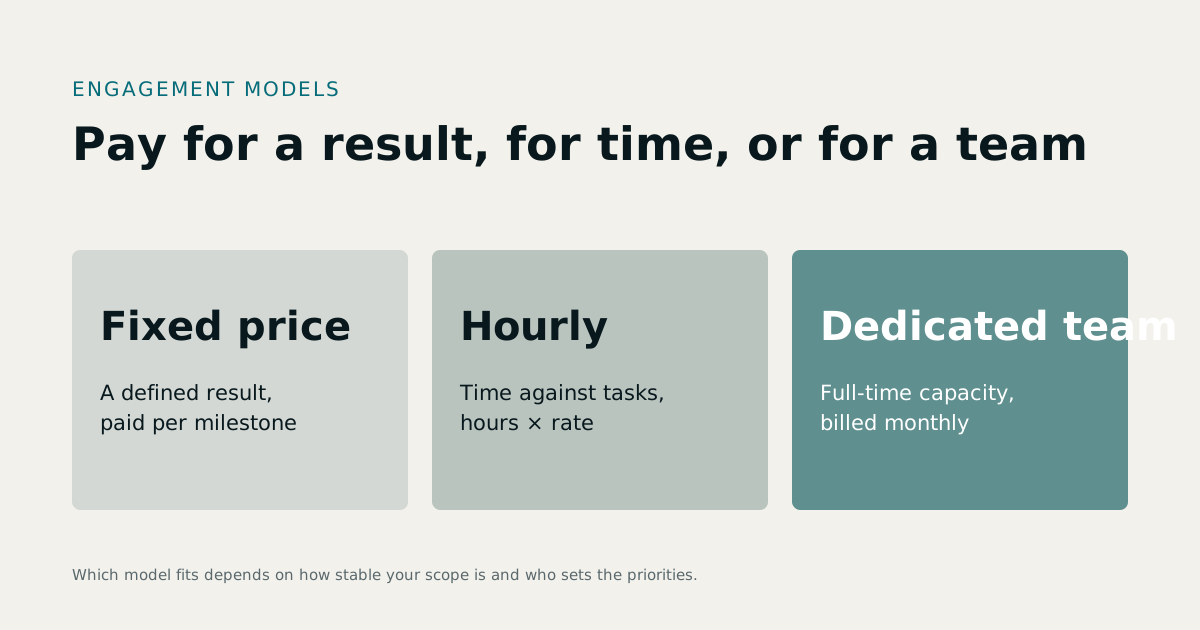
There are four models, and none is best for everyone. The table shows how they compare for an early-stage MVP. The pattern is consistent with the comparison from SPD Load, though the "best stage" column is our own view.
| Model | Speed to start | Cost level | Your control | Bus-factor risk | Best stage |
|---|---|---|---|---|---|
| In-house hire | Slow (weeks to months) | High | High | Medium: depends on one or two people | After product-market fit |
| Freelancer | Fast | Low to medium | Medium | High: one person holds everything | Small, fixed tasks; prototypes |
| Agency | Medium | Medium to high | Low to medium | Low | A defined build with little ongoing work |
| Dedicated developers | Fast | Medium | Medium to high | Low to medium | Steady work over several months |
The trade-offs are real, and the freelancer vs agency choice mostly depends on how clear your scope is.
A freelancer is cheaper for a small, well-defined job: a landing page, a prototype, a single integration. The risk is that everything lives in one person's head. If they get ill, take a full-time offer or go quiet, you may have nothing usable.
An agency suits a defined build. If the scope is clear and you expect little change afterwards, a fixed-scope project can work well. It is a poor fit when you expect to learn and change direction every fortnight, because each change becomes a negotiation.
Dedicated developers cost more per month than a cheap freelancer. They pay off when the product needs steady work over several months, because the same people learn your product and you don't re-brief anyone. At Treevoxa, dedicated developers work only on your product, with a daily overlap in your working hours. Agree a working rhythm before you start, such as fortnightly sprints with a demo at the end of each. The hire developers page explains how engagements are set up, and our guide to the dedicated development team model covers how it works and what it costs.
In-house is the right call later. It carries recruitment time, salary, equipment and management, and it makes sense once you know what you are building.
Which role do you hire first?
Use complexity as the rule.
- Simple web MVP (sign-in, a few screens, one payment or email integration): one strong full-stack developer can carry it, ideally with a few hours of design help.
- Anything with mobile apps, payments, several integrations or user roles: start with a small team. That means a developer or two, a designer and a tester. Add a part-time project lead to turn your scope into a task list and run the weekly demo.
The mistake to avoid is hiring one developer for a job that needs a team, then wondering why testing and design never happen.
4How much does it cost to hire MVP developers?
Prices vary widely, and published ones rarely show their working. Here is a simple method for MVP development cost: hours multiplied by rate. For a wider view, see our custom software development cost guide.
The rates in this table are vendor-claimed, from Chrono Innovation. We used 300 hours for every row so the rates compare like for like. That figure is our illustrative assumption for a modest MVP, within the 200 to 500 hours the same source uses. It is not a quote, and real hours depend on scope, not on who builds it.
| Provider (vendor-claimed rate) | Rate per hour | Hours (assumed) | Illustration |
|---|---|---|---|
| Eastern European agency | $50–100 | 300 | $15,000–30,000 |
| Freelancer | $80–200 | 300 | $24,000–60,000 |
| North American agency | $150–250 | 300 | $45,000–75,000 |
The freelancer range is wide because the rate range spans juniors to senior specialists. A senior freelancer can cost as much per hour as a good agency, so the title on the invoice tells you little. The cheapest rate is also not always the cheapest outcome, because rework and delays cost money too.
The sources also give whole-project figures. All are vendor claims:
| Claim | Source |
|---|---|
| Freelancer: $16K–100K for 200–500 hours; agency MVP $60K–200K over 4–6 months | Chrono Innovation |
| Core-scope MVP: $17,700–35,400 with a freelancer; $30,350–60,700 with an agency (US rates) | Project Cost Estimator |
| US mid-tier agencies: $50K–200K in 8–20 weeks at $125–200 an hour; in-house team $500K+ a year | Bolder Apps |
Why do they disagree? Scope, region and seniority. A web app with one user type is not a marketplace with payments and a mobile app. A junior freelancer and a senior engineer are not the same product.
How does location change the price?
We won't invent regional numbers, but the pattern is steady:
- Local teams in the US, UK, UAE, Australia and Singapore sit toward the higher end, because local salaries and overheads are higher. In Chrono Innovation's figures, North American agencies charge $150–250 an hour against $50–100 for Eastern European ones. You get the same time zone and easy meetings. We have pages for US, UK, UAE, Australian and Singapore companies.
- Offshore teams usually cost less per hour. The catch is time-zone gaps and communication, which is why a guaranteed daily overlap matters. More on offshore software development.
Rates also vary by city and seniority within any region, so ask for a written quote instead of relying on a region's reputation.
What does it cost with Treevoxa?
For our rates, see Treevoxa's software development rates. For a rough figure for your own scope, try the software development cost calculator.
What costs are easy to miss?
- Rework caused by a vague scope.
- Your own time managing the work.
- Hosting, domains, email and third-party services.
- Post-launch fixes. Budget for them from the start.
5Where do you find MVP developers?
Each source has trade-offs.
- Referrals. The best signal, because someone has seen the person work. Limited by who you know.
- Freelance platforms (Upwork, Toptal). Wide choice and quick to start. Screening differs by platform, so check what each one actually vets and expect to do some vetting yourself.
- LinkedIn and GitHub. Good for finding people and seeing their public work. Expect to do outreach and to wait for replies.
- Agencies and vetted partners. Less searching for you. Check that the people you meet are the people who will build.
- Offshore teams. Lower cost and large talent pools. Check time-zone overlap before anything else. Our offshore software development page covers how that works for us.
Whichever you use, talk to three to five candidates, not one. Comparing them teaches you what good sounds like.
6How do you vet developers if you can't read code?
You can judge a lot without reading a line. Look at what they have shipped, how they talk about trade-offs and how they behave when the work gets messy.
| Ask | A good answer sounds like | A weak answer sounds like |
|---|---|---|
| "Show me something you shipped that I can open and use." | A live product, plus what they personally built | Screenshots, NDAs for everything, "the client took it down" |
| "Can I speak to two or three past clients?" | Names and contacts offered readily | Excuses, or only handpicked testimonials |
| "I want to change a feature mid-build. What happens?" | Explains the effect on time and cost, offers options | "No problem, anything is possible" |
| "How do you test?" | Describes who tests, when, and what happens before release | "We test as we go" with no detail |
| "How will I know how it's going?" | Regular demos, a visible task board, short written updates | Updates only when you chase |
| "Who owns the code, and where does it live?" | "You do, in your repository, from day one" | Hedging, or "after final payment" |
What is a paid one-week pilot?
It is the most useful vetting step, and many founders skip it. Pay for one week of real work before you commit to months.
- A small, real task. A slice of your actual product: for example, sign-in plus one working screen. Not a throwaway test.
- Your repository. The work goes into an account you own, so you can see the commits and keep the result either way.
- A demo at the end. You see it working, on a link you can open.
- Pass criteria written beforehand. For example: it runs as described, the demo happens on time, questions were asked early, and the code is in your repository with basic notes on how to run it.
If you can't judge the result yourself, an independent technical review is an option. A reviewer reads the code and tells you plainly whether it is sound.
7What should the contract and handover say?
Put the basics in writing before work starts:
- Code and IP ownership. Everything built for you is assigned to you, not licensed.
- Your accounts. The code repository, cloud hosting, domains and app-store accounts sit in your name from day one. The developer is given access, not the other way round.
- Documentation and handover. How to run, deploy and change the system, written as you go.
- Notice period. How much warning each side gives before ending the work, and what the developer hands over in that time.
- Confidentiality. Covers your idea, your data and your customers.
- Payment. By milestone for a fixed scope, or monthly for a dedicated team. Avoid paying everything upfront.
Two warnings. IP assignment rules and employment-status rules differ by country, and a contractor who works full-time for one client can be treated differently from a part-time one. Take legal advice for your country. And a solo freelancer is a bus-factor risk: if that one person disappears, so does the knowledge. Your own repository and written notes are the protection.
Code ownership is something we take seriously across our work. Our page on ready-made software with source code shows what handing over full source code looks like.
8What are the red flags when hiring developers?
- A fixed price quoted before anyone has asked you a question about scope.
- "Top 1%" claims with no shipped work to open and use.
- No access to the repository, or code held on their accounts.
- A refusal to do a paid pilot.
- A team that never pushes back on your scope. Good developers say "not yet" to some features.
- Many short job tenures on a CV, with no clear reason.
- No testing plan.
- Vague answers on who owns the code.
One or two of these may have an innocent explanation. Several together should end the conversation.
9Should you use AI tools or no-code instead?
Sometimes, yes, as a first step. A no-code prototype or a simple landing page can test whether anyone wants your idea before you pay for a build. Project Cost Estimator puts a landing-page validation build at $1,950–3,900 (a vendor claim). If the answer is no, you have saved a lot of money. Chrono Innovation also describes AI-supervised builds at $15K–60K. That is their claim, and it depends heavily on scope.
AI-assisted development also makes experienced developers faster. But it does not replace someone who owns the architecture, security and maintenance. Generated code still has to be reviewed, tested and kept up to date. The risk is a product that looks finished but is hard to change, or has security gaps nobody has checked.
A sensible rule: use no-code to test demand, and hire developers once real users and real data are involved.
10How long does an MVP take?
Sources vary. US mid-tier agencies quote 8 to 20 weeks, per Bolder Apps. Chrono Innovation quotes 4 to 6 months for an agency MVP.
What moves the number:
- Scope. More features, more time.
- Integrations. Each one adds testing and risk.
- Mobile apps. They add time if you need iOS and Android as well as web.
- Design readiness. Finished designs save weeks.
- Your decision speed. Slow answers from you stall the build more than anything else.
11What happens after launch, and when should you hire in-house?
Users find bugs you didn't, ask for things you hadn't planned, and your second release shapes the product more than the first.
Plan for:
- Maintenance. Security updates, hosting, backups and fixes. Budget for it monthly.
- Bug fixes. A clear way to report them and a response time you agree in advance.
- The second release. Based on what users actually do, not on your original wish list.
Consider moving in-house when three things are true: you have product-market fit, you have a steady roadmap, and you have funding for a full team. In-house is expensive. Bolder Apps puts a full in-house team at $500K+ a year, again a vendor claim.
To make the move smooth, keep your repository tidy, your documentation current and your accounts in your own name. A dedicated team can then hand over to your first hires with their knowledge written down, and ideally overlap with them for a few weeks.
12Conclusion: how to hire developers for a startup MVP
Knowing how to hire developers for a startup MVP comes down to three habits: be clear about scope, test early with a paid pilot, and keep the repository in your own name.