
To choose a custom software development company, write a one-page brief, shortlist three firms, test each on proof, process and contract terms, score them on a weighted sheet, and run a small paid pilot before you commit. The same method works whether you need custom software development for a gym, a pharmacy, a factory or a finance team. This guide shows how to choose a custom software development company without being able to judge a tech stack, including how to ask about AI coding tools.
The five steps:
- Define the problem, users, budget and deadline on one page.
- Check whether you need custom software at all.
- Shortlist three companies and score them with the scorecard below.
- Test them with sales-call questions, reference calls and a like-for-like quote comparison.
- Contract and pilot. Agree source code ownership and exit terms, then start with a paid pilot.
1What should you define before you contact anyone?
Write a one-page brief. A vague brief gets vague quotes, and vague quotes can't be compared.
Include:
- The problem. "Our front desk spends two hours a day reconciling memberships" beats "we need an app".
- The users. Who logs in, how many, and from which devices.
- Must-have workflows. Five to ten things the system must do on day one. Put everything else on a "later" list.
- Systems to connect. Accounting software, payment gateways, attendance devices, WhatsApp, an existing database.
- Budget range. Give a range, not a secret. A firm that knows your ceiling can propose a sensible first phase.
- Deadline and the reason for it. A fixed launch event is different from "as soon as possible".
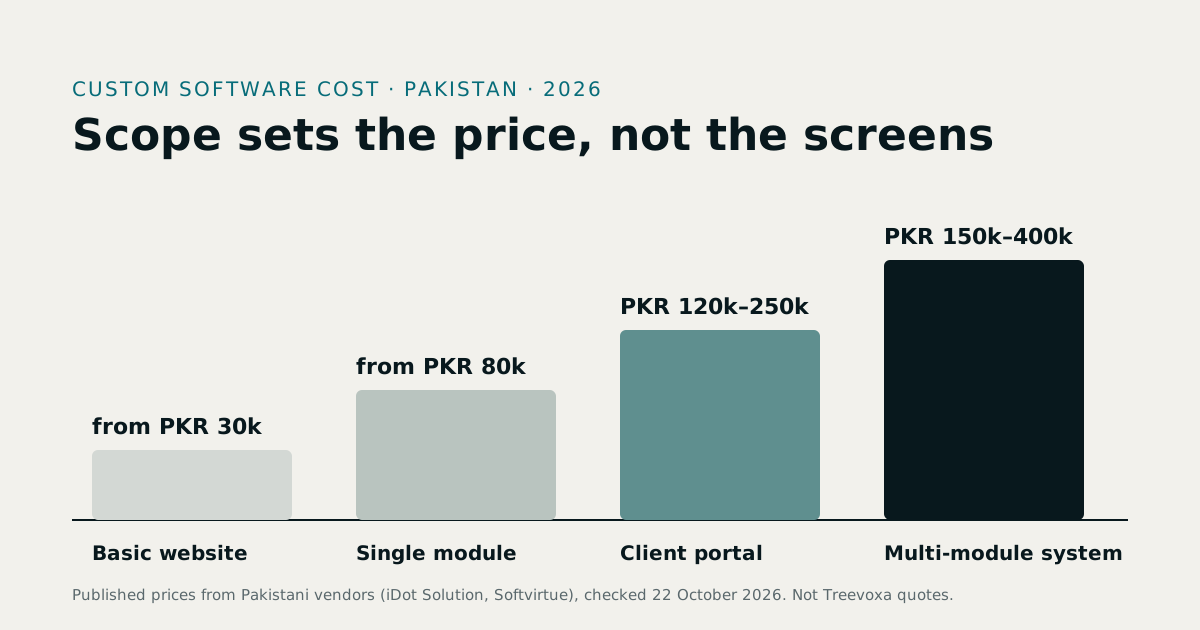
For budget framing, look at our software development rates, then run your brief through the software cost calculator for a first estimate. Our custom software development cost guide gives a USD price range to check against. Treat the result as a sanity check on the quotes you receive, not a promise.
2Do you need custom software at all?
Sometimes you don't. Custom is the right call when your process gives you an edge, or when off-the-shelf tools force workarounds that cost real time every week. It is the wrong call in these cases:
- Your processes are standard. Invoicing, basic stock control and payroll are solved problems.
- Your team is small and the budget is tight. A per-user SaaS subscription beats a build you can't finish. The custom software vs SaaS decision is mostly about how much your process differs from the standard one; our guide to custom software vs SaaS walks through it.
- A configurable platform already fits. Odoo or ERPNext often covers most of what you need, with customisation for the rest. Our comparison of custom ERP vs Odoo vs ERPNext sets out where each wins.
- You need it fast. Buying beats building when the deadline is this quarter.
There is also a middle route: ready-made software with source code. You buy a working system, get the full code, and customise from there. You skip the first months of building and still own what you run.
3Which type of partner fits you?
The models differ in who manages the work and who is accountable when it goes wrong. Besides a software development company, you can use freelancers, hire an in-house team, buy staff augmentation, or take a dedicated team.
| Model | Who manages the work | Who is accountable | Best for | Main risk |
|---|---|---|---|---|
| Software development company | The company | The company, for an agreed outcome | Owners with no technical team | Quality varies by firm, so vet it |
| Freelancers | You | Each person separately | Small, well-defined tasks | No one owns the whole system |
| In-house team | You | You | A long-term core product | Slow hiring, salaries, turnover |
| Staff augmentation | You | You; the supplier only provides people | Firms with a technical lead already | You carry all the delivery risk |
| Dedicated team | Shared | Shared, depending on the contract | Ongoing roadmap work | Priorities need a clear owner |
A software development company delivers an outcome: a working system, accepted against an agreed scope. Staff augmentation supplies people, and you direct them. If nobody on your side can judge code or run a sprint, staff augmentation will hurt.
If you already have a technical lead and want extra capacity, see how to hire developers. A dedicated team suits a long roadmap, but only if someone on your side owns priorities. Our guide to the dedicated development team model explains how it works and what it costs.
4How do you choose a custom software development company?
Use a scorecard so the decision isn't made by whoever gave the best presentation. Score each firm from 1 to 5 on each criterion. Multiply each score by its weight, add them up, then divide by 5. The total is out of 100.
| Criterion | Weight | What a good answer looks like |
|---|---|---|
| Relevant proof | 20 | Live products in production; a reference in a similar business you can phone |
| Process and discovery | 15 | Paid discovery, written scope, a demo every sprint or two |
| Communication | 15 | A named contact, fast clear replies, honesty about trade-offs |
| Technical fit | 10 | A mainstream stack you can hire for later, explained in plain English |
| Contract and ownership terms | 15 | You own the code on final payment; handover and exit terms in writing |
| Security | 10 | Access controls, backups, code review, a clear approach to your data |
| Support | 10 | A written warranty and support plan with response times |
| Price clarity | 5 | An itemised quote; change requests priced up front |
Here is a worked example. The vendors and scores are illustrative.
| Criterion (weight) | Vendor A | Vendor B | Vendor C |
|---|---|---|---|
| Relevant proof (20) | 4 | 3 | 5 |
| Process and discovery (15) | 3 | 2 | 4 |
| Communication (15) | 4 | 3 | 4 |
| Technical fit (10) | 4 | 4 | 3 |
| Contract and ownership (15) | 5 | 2 | 4 |
| Security (10) | 3 | 2 | 4 |
| Support (10) | 4 | 2 | 3 |
| Price clarity (5) | 3 | 5 | 4 |
| Weighted total (out of 100) | 77 | 54 | 80 |
Suppose Vendor B also had the lowest quote and the smoothest pitch. It still scored low on process, contract terms, security and support. That is the point of the sheet: it stops price and polish from outvoting the things that hurt you later.
A and C are close. When the gap is under five points or so, don't agonise. Run a pilot with your top choice, or with both.
5How do you tell a real portfolio from a sales pitch?
Anyone can show polished screenshots. Ask for things that are hard to fake:
- A live product in production. Ask to see it running, not a slide deck.
- A client in a similar business whom you can phone. Ten minutes with them tells you more than any case study.
- Screenshots of real data, not mock-ups with placeholder text and round numbers.
- The named engineer who built it. Ask whether they will work on your project.
- Whether the team runs its own products. A firm that has to keep its own software alive at 2am has a reason to build things that are easy to support. That can be a useful signal.
Here is our own position. Treevoxa builds and runs its own SaaS products, and you can judge the products we build and run yourself. We carry the support burden of what we ship. That is one signal, not proof. You should still phone references, read the contract and run the scorecard on us as you would on anyone else.
6What should you ask a software company on the sales call?
Good questions reveal how a firm thinks. Here are fifteen, grouped by theme. Write down the answers so you can score them later.
Process
- How do you run discovery, and is it paid? What do I get at the end of it?
- Will I see working software every sprint or two, or only at the end? Ask them to explain their approach to software development methodologies in plain English; if they can't, that tells you something.
- Who is the lead engineer on my project, and can I speak to them before I sign?
Team
- Who actually writes the code: your employees, contractors or a subcontractor?
- What was your staff turnover last year, and what happens if my lead leaves mid-project?
- How big is the team you'd assign, and are they shared with other projects?
Money
- What does this quote leave out?
- How do you price change requests, and who approves them?
- What are the payment milestones, and are they tied to working demos?
Risk
- If I leave, what do I get, and how quickly? Can you show me your standard handover?
- Where will the system be hosted, and in whose account?
AI-assisted development
- Which AI coding tools do you use, and on which parts of the work?
- Who reviews AI-generated code before it ships, and what testing catches mistakes?
- Does AI use change your price or timeline? If it saves you time, how do I see the saving?
- Are my data and code kept out of public models and third-party training?
A good answer to the AI questions is specific. It names the tools, the reviewer and the testing, and it explains where the tools are not used. Vendors often say AI speeds up routine work. Ask to see how that shows up in your plan and price. A weak answer is either "we don't use it" with no reasoning, or "AI does most of it" with no named reviewer. For the wider picture, see what comes after AI.
7Fixed price vs time and materials: which is safer?
Neither is safe on its own. They move risk to different people.
- Fixed price. You agree scope and price. The vendor carries the cost risk, so they pad the quote and resist changes. It works when scope is stable and well documented.
- Time and materials. You pay for hours worked. You carry the cost risk but keep flexibility. It works when requirements will change as you learn.
- Hybrid. Pay for discovery first, then take a fixed price per phase. For most business systems this is the safest route, because the fixed price rests on a scope you've both tested.
Here is a worked example. The figures are illustrative, not market prices.
Assumptions: a CRM estimated at 600 hours at $100 an hour, so $60,000 of effort. The fixed-price quote is $66,000, which includes a 10% buffer. The time and materials deal has a monthly cap of $11,000 for six months, so $66,000 in total. In the growth scenario, scope grows by 25%, which is 150 extra hours, or $15,000.
| Scenario | Fixed price | Time and materials, no cap | Time and materials, $66,000 cap |
|---|---|---|---|
| Scope stays stable | $66,000 | $60,000 | $60,000 |
| Scope grows 25% | $81,000 if every change is billed | $75,000 | $66,000, with about $9,000 of low-priority work cut, or more budget approved |
A fixed-price vendor may use its buffer to absorb some of the growth, so your real bill could land between $66,000 and $81,000. That depends on how the change-request clause is written.
Fixed price buys predictability when scope is stable, but you pay for the buffer. Time and materials costs less when things go well. A cap gives you a decision point when they don't, as long as the cap and the approval rule are written down. To see how a CRM is scoped in practice, look at our CRM development service, the CRM development cost guide and the software cost calculator. For hourly rates, see software development rates.
8How do you compare three quotes fairly?
Quotes arrive in different shapes. One is a single number; another has twelve lines. Put them into the same table before you compare.
| Line item | What to check | Often left out |
|---|---|---|
| Discovery | Paid, with a written scope as the output | "Included" but never defined |
| Design | UX and UI, number of revisions | Branding and design systems |
| Build | Features listed against your must-haves | Admin screens, user roles |
| Testing | Who tests, and how | Automated tests, load testing |
| Data migration | Which old systems, how clean the data is | Frequently missing entirely |
| Integrations | Each one named | Third-party API fees |
| Hosting | Whose account, monthly cost | Backups and monitoring |
| Training | Sessions, documents, videos | Often absent |
| Warranty | Length and what it covers | Often vague |
| Support | Response times, monthly price | Often a separate quote |
Published hourly rates and project averages vary widely by region, seniority and source, and they date quickly. Use any blog figure as a rough guide at best. Our own numbers are on the software development rates page, and the software cost calculator gives a first estimate from your brief.
If you are buying an ERP, the lines above multiply: more modules, more integrations, more migration. Our ERP software development page shows how those pieces are usually scoped, and the ERP development cost guide covers what a custom ERP really costs.
9What red flags should make you walk away?
| Red flag | Why it matters | What to do |
|---|---|---|
| Price given in a day with no questions | They haven't understood your problem | Ask for a discovery proposal instead |
| No references you can phone | Past clients may not vouch for them | Make references a condition of the next step |
| Won't name the team | You may get juniors or subcontractors | Ask for the lead engineer by name |
| No demos until launch | Problems surface late, when they cost most | Insist on demos every sprint or two |
| Vague on code ownership | You may end up renting your own system | Get ownership terms in writing first |
| Pressure to sign this week | Pressure serves them, not you | Walk away from "limited time" pricing |
| No testing plan | Bugs become your problem after launch | Ask who tests and how |
| 100% payment upfront | You lose all leverage | Pay by milestones tied to working software |
| Hosting only in the vendor's account | You can't leave without their permission | Put hosting and credentials in your accounts |
One red flag may be a poor answer to a fair question. Three or more is a pattern.
10What should the contract say about source code ownership?
Most owners focus on price and miss the clause that matters most when a relationship ends. Source code ownership decides whether you can switch vendors, hire your own team, or keep running if the firm closes. This checklist is a starting point; have a lawyer review the final contract.
| Contract item | What it should say |
|---|---|
| Source code ownership and licence | Ownership, or a perpetual licence, passes to you on final payment |
| Repository access | You get access to the repository, not just a zip file at the end |
| Credentials and hosting | Servers, domains and cloud accounts sit in your name |
| Documentation | Setup guide, architecture notes, deployment steps |
| Named lead engineer | Named in the contract, with notice if they change |
| Milestone payments | Tied to working demos, not calendar dates |
| Change-request pricing | Rate and approval process agreed in advance |
| Warranty period | A fixed period for fixing defects at no charge |
| Support terms | Response times, hours covered, monthly price |
| Exit and handover | The vendor helps a new team take over, with costs stated |
| Confidentiality | Covers your data, designs and business rules |
| Third-party and open-source licences | A list of what's used and under which licences |
Source code escrow is an option when the vendor keeps ownership, for example on a licensed product. A neutral third party holds the code and releases it to you if the vendor fails. It adds cost, and it only helps if the escrowed code is current and tested.
The simpler route is to own the code outright. That's how our ready-made software with source code works: you get the full code, not a lease.
11Is an offshore software development company worth it?
Sometimes. It can cut cost and widen your choice, but it only works with strong process: written scope, regular demos and a named contact in your time zone. Location matters for five practical reasons:
- Time-zone overlap. Even three or four shared hours a day keep a project moving.
- Language. Can they explain trade-offs plainly, in writing and on calls?
- Data law. Data protection rules differ by country, and in the US by state. Check the local requirements with counsel rather than relying on a vendor's assurance.
- Currency and tax. Paying in a foreign currency adds exchange-rate risk, and withholding or VAT rules may apply.
- Ease of visits. Some owners want an occasional meeting in person.
Read our notes on offshore software development. If you're buying in a specific market, we have pages for US companies, UK companies, UAE companies, Australian companies and Singapore companies. Canadian buyers can read our guide to hiring offshore developers for Canadian businesses.
12How do you run a small paid pilot before committing?
A pilot is the cheapest insurance you can buy. Pay for a two to four week discovery or pilot with one clear deliverable, such as:
- a clickable prototype of your three main screens,
- one working workflow, end to end, on real or realistic data, or
- a demo of the riskiest integration.
Before you start, write down what a good result looks like. For example: "A front-desk user can sign up a member, take a payment and print a receipt without help." Also write down the exit. You pay for the pilot, receive everything produced, and walk away if it doesn't meet the test.
Watch how the team behaves, not just what they deliver. Do they ask good questions? Do they flag problems early? Do they ship on the day they promised?
A pilot is a natural fit for MVP development. If you want an independent view of scope before spending more, software consulting is the usual route.
13What happens after launch?
Launch starts the running cost; it doesn't end the spend. Get a support plan in writing that covers:
- Warranty. A period when defects found in the agreed scope are fixed free.
- Support. Hours covered, response times, and who answers at 2am if the system is down.
- Hosting and monitoring. Who watches uptime, who restores backups, and what it costs per month.
- Updates. Security patches and library upgrades, which can't wait.
- Change requests. How new features are priced once the warranty ends.
Expect an ongoing yearly cost for support and maintenance, and budget for it from the start. Percentages quoted online vary, so ask each vendor for a real figure and exactly what it includes.
14What is the short version?
The short version of how to choose a custom software development company is evidence over presentation. Write the brief. Check whether you need custom at all. Score three firms on the same sheet and phone their references. Compare quotes line by line. Read the source code ownership and exit clauses. Prove the working relationship with a paid pilot before you commit to the full build.